 Veda Store

- Navodaya Vidyalaya Notes
- JNVST Arithmetic Notes class 6
Chapter 7 Lines and Angles
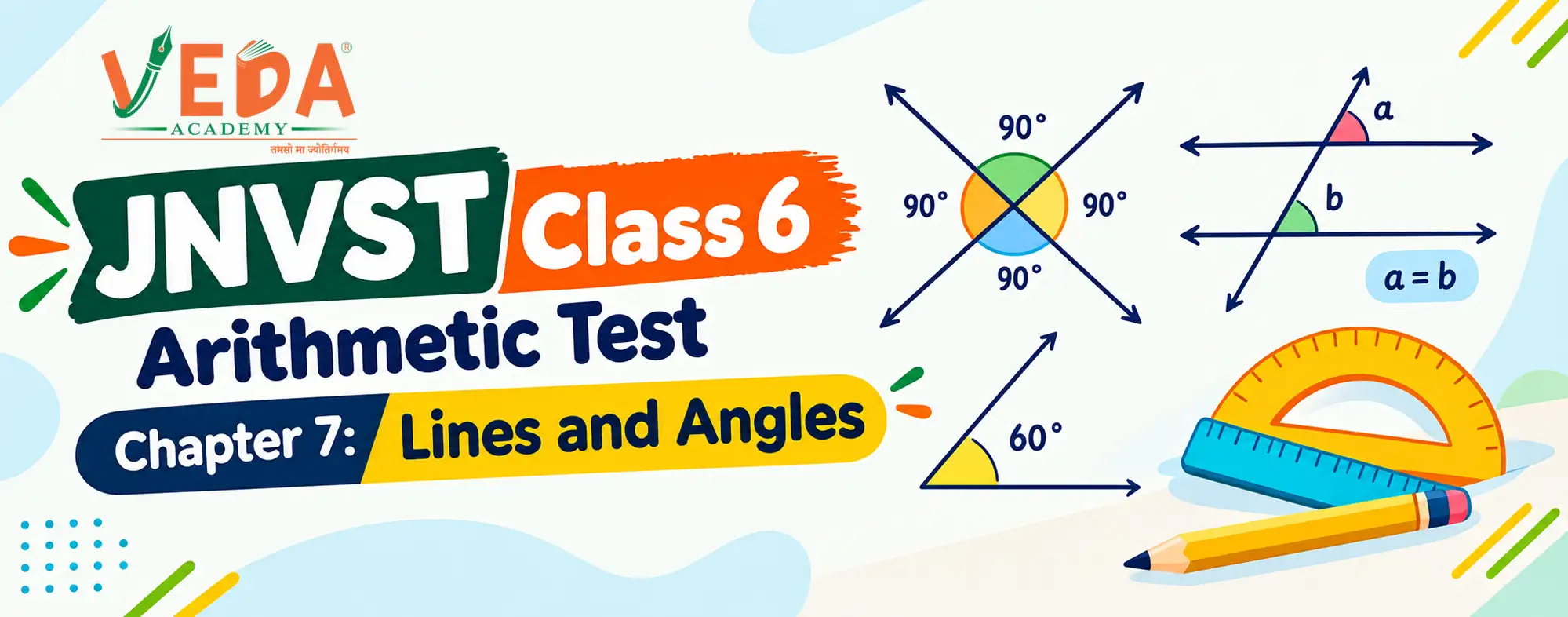
JNVST Class 6 Arithmetic Test Chapter 7: Lines and Angles
Are you preparing for the JNVST exam? Do you want to make your maths practice easier? Next, studying the Lines and Angles section becomes significant. Through this topic, one can learn about shapes, lines, angles, and curves. The JNVST Class 6 Arithmetic Test Lines and Angles section is easy to grasp after studying the basics. After that, one can easily answer the questions. In addition, consistent practice will increase speed and accuracy.
In this chapter, we will learn about lines, rays, line segments, and angles. We will also look at different types of angles. Finally, you will learn some simple tips for JNV exam preparation. For better preparation, students can also go through arithmetic notes, important questions, mock tests, model papers, and the JNVST syllabus.
What Are Lines and Angles?
A line is a straight path that goes in both directions. It has no end points. On the other hand, a line segment has two end points. A ray starts at one point and goes in one direction. Therefore, a line, line segment, and ray are not the same. An angle is made when two rays meet at one point. The meeting point is called the vertex.
For example, look at the corner of a book. It shows an angle. Similarly, the hands of a clock can make different angles.
Types of Lines
There are various categories of lines that students should know in Class 6 JNVST Arithmetic, as follows:
Horizontal Line: A line that goes from left to right. It looks like this:
────────. For example, the edge of a table can look like a horizontal line.
Vertical Line: A vertical line moves up and down. It looks like this:
│. For example, a standing pole is similar to a vertical line.
Slanting Line: A slanting line moves in a tilted direction. It does not go straight up, down, or sideways.
/. Therefore, it is also called an inclined line.
What Is a Line Segment and Ray?
A Line Segment is a part of a line. It has two fixed endpoints. For example:
A ───────── B. Here, A and B are the endpoints. The part between A and B is the line segment. Remember this simple rule: Line segment = 2 endpoints. This idea is useful during JNVST exam practice because many questions test basic definitions.
A ray has one fixed endpoint. It goes on forever in one direction. For example: A ─────────→.Here, A is the starting point. The arrow shows that the ray continues in one direction. So, remember: Ray = 1 endpoint. An angle is formed when two rays meet at one point. The common point is called the vertex. For example, an angle can look like this: ∠ABC. Here, B is the vertex because both rays meet at B. Therefore, when you name an angle with three letters, the middle letter is the vertex. Angles have different sizes. So, they are divided into different types. 1. Acute Angle An acute angle is smaller than a right angle. It is more than 0° but less than 90°. For example, 45° is an acute angle. 2. Right Angle: A right angle measures exactly 90°. The corner of a square is a good example of a right angle. You may see this angle often in JNVST Class 6 Arithmetic Test Lines and Angles questions. 3. Obtuse Angle: An obtuse angle is bigger than 90° but smaller than 180°. For example, 120° is an obtuse angle. 4. Straight Angle: A straight angle measures exactly 180°. It looks like a straight line. Therefore: Straight angle = 180° 5. Reflex Angle: A reflex angle is bigger than 180° but smaller than 360°. For example, 270° is a reflex angle. 6. Complete Angle: A complete angle makes a full turn. It measures 360°. For example, when you turn all the way around, you make a complete angle. The JNVST Class 6 Arithmetic Test Lines and Angles topic helps students build basic math skills. It also helps them understand shapes and measurements. During JNV exam preparation, students should learn each type of line and angle. They should also practice simple questions. However, only reading is not enough. You should solve questions after learning each concept. As a result, you can remember the topic for longer. Good practice can make this topic much easier. Follow these simple steps. Learn the Basics First: First, learn the meaning of a line, ray, and line segment. Then, learn the types of angles. Make Small Notes: Next, write important facts in a notebook. For example, write: Right angle = 90° Straight angle = 180° Complete angle = 360° Acute angle < 90° Obtuse angle > 90° and < 180° Practice Every Day: Try to solve a few questions every day. Even 15 to 20 minutes can help. Also, check your mistakes after every practice session. Take Mock Tests: Mock tests help you understand your preparation level. They also help you manage your time. Therefore, include chapter tests and full mock tests in your JNV exam preparation plan.What Is an Angle?
Types of Angles
Why Is This Topic Important for JNVST?
How to Prepare for Lines and Angles for Class 6 JNVST
Chapter 7 Lines and Angles PDF
Do You Need Help With Your Homework
Choose the Best Online Classes for Navodaya Vidyalaya Class 6
The right guidance can make learning easier. Students need simple explanations, regular practice, and useful study material.
Veda Academy offers learning support for students preparing for the JNVST exam. Lessons can help students understand concepts step by step. In addition, practice questions can help them build confidence. If you are looking for the best online classes for Navodaya Vidyalaya Class 6, choose a learning program that focuses on concepts, practice, revision, and mock tests.
Why Best Coaching for Navodaya Vidyalaya Class 6 Is Important
Good coaching should make difficult topics simple. It should also help students practise questions regularly. For this reason, students preparing for the JNVST Class 6 Arithmetic Test Lines and Angles should use easy lessons and regular tests. They should also revise topics that they find difficult.
Veda Academy can support students with structured learning for JNV exam preparation. With regular practice, students can improve their math skills and prepare with greater confidence. Lines and angles become easy when you practise them often. First, understand the basic terms. Next, learn the angle types. Then, solve questions without looking at the answers. Also, revise your mistakes. If you get a question wrong, try it again. This small habit can improve your accuracy. Most importantly, do not fear math. Take one topic at a time and keep practising. With the right study plan, regular practice, and proper guidance, you can make your JNVST Class 6 Arithmetic Test Lines and Angles preparation simple and effective.Final Tips for JNVST Preparation