 Veda Store

- Navodaya Vidyalaya Notes
- JNVST English Language Notes class 6
English Language Chapter 2
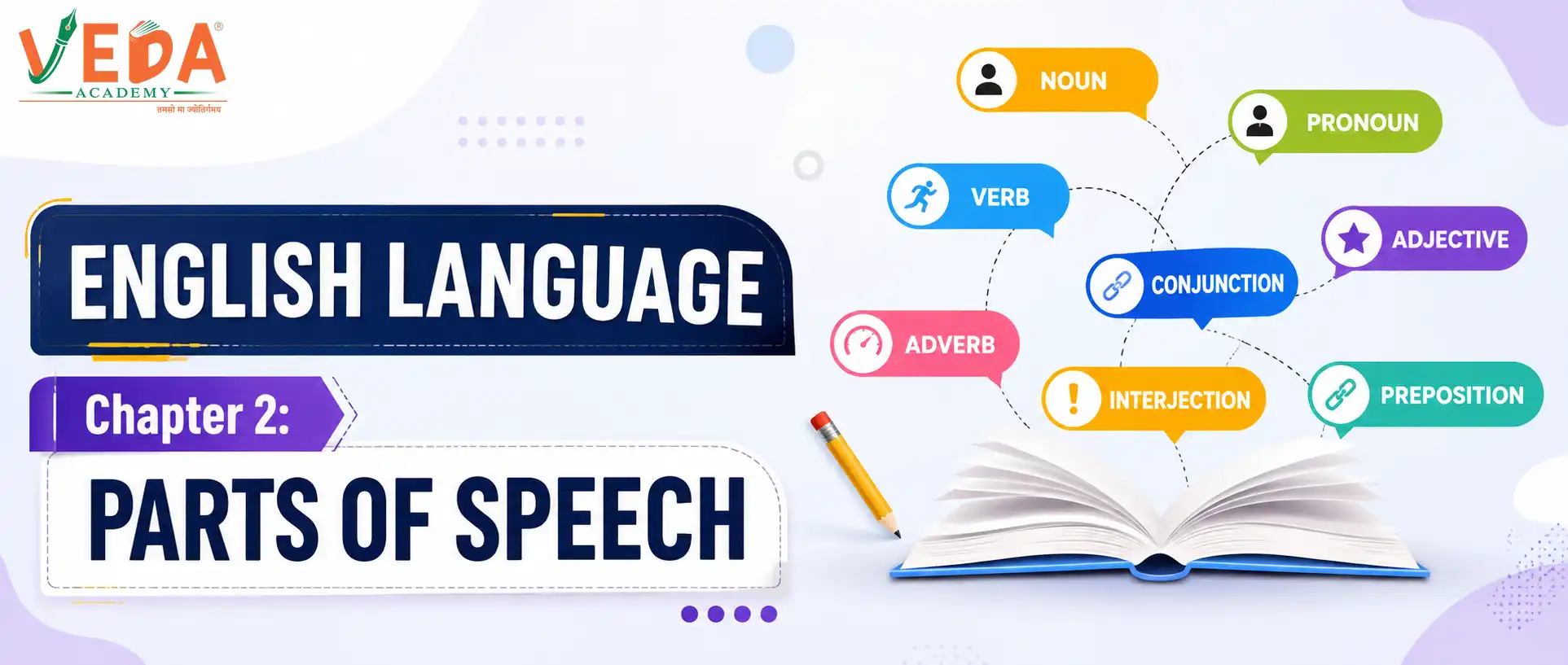
JNVST Class 6 English Language Chapter 2: Parts of Speech in a Simple Way
Learning English becomes easier when students understand how words work in a sentence. JNVST Class 6 English Language Parts of Speech is an important topic for students preparing for the Navodaya entrance exam. It helps students learn the role of each word in a sentence.
Moreover, JNVST Class 6 English Language Parts of Speech helps students improve grammar, reading, and writing skills. Therefore, students should learn each type of word with simple examples.
In Navodaya Class 6 English Language, grammar questions can test a student's basic understanding of words and sentences. As a result, learning Navodaya Class 6 English Language Chapter 2 can help students build a strong grammar base. Therefore, Veda Academy provides the best online classes for Navodaya Vidyalaya Class 6. Students get JNV Notes, Important Questions, and model papers. They can practise more with these; it will build confidence in them to crack the JNV exam.
English Language Chapter 2 PDF
Do You Need Help With Your Homework
What are Parts of Speech?
Parts of speech are groups of words based on the work they do in a sentence. For example, a word can name a person, show an action, describe something, or join two ideas. The main parts of speech are:
Noun
Pronoun
Verb
Adjective
Adverb
Preposition
Conjunction
Interjection
Understanding JNVST Class 6 English Language Parts of Speech makes grammar easier. Also, it helps students find the correct answer in many grammar-based questions.
Noun: It is said to be a naming word. It names a person, place, animal, thing, and idea. For example:
Yash is a notorious boy.
He lives in Delhi
He had a Cat as a pet.
He has black earbuds.
Yash, Delhi, Cat, and Earbuds are nouns here. Hence, the basic part of speech is nouns. The students must learn to find nouns in simple sentences.
Pronoun: A pronoun is a word used instead of a noun. It helps us avoid repeating the same name. For Examples:
Rohan is happy. He is smiling.
Sara has a bag. She likes it.
The boys are playing. They are happy.
Here, he, she, and they are pronouns. Therefore, pronouns are also important in Navodaya Class 6 English Language Chapter 2. Students can practise them by replacing names with words such as he, she, it, and they.
Verb: A verb shows an action or state. For Examples:
Birds fly.
Children play.
She reads a book.
We are ready.
Fly, play, reads, and are are verbs. Next, students should focus on verbs because they form an important part of JNVST Class 6 English Language Parts of Speech. A simple way to find a verb is to ask, “What is the person or thing doing?” Adverb: An adverb gives more information about a verb. It often tells us how, when, or where an action happens. For Examples: The boy runs quickly. She sings well. He came yesterday. They played outside. Quickly, well, yesterday, and outside are adverbs. Furthermore, learning adverbs helps students understand Navodaya Class 6 English Language questions more easily. Adjectives: An adjective describes a noun or pronoun. It tells us more about a person, place, animal, or thing. For Examples: She has a red dress. He is a tall boy. It is a beautiful flower. I have three pencils. Red, tall, beautiful, and three are adjectives. So, adjectives make sentences more clear and interesting. They are another key part of JNVST Class 6 English Language Parts of Speech. Conjunction: A conjunction joins words or sentences. For Examples: Riya and Siya are friends. I wanted to play, but it rained. Hurry up or you will miss the bus. I stayed home because I was sick. And, but, or, and because are conjunctions. Therefore, conjunctions help us connect ideas. They are an important topic in Navodaya Class 6 English Language Chapter 2. Interjection: An interjection shows a sudden feeling or emotion. For Examples: Wow! That is a beautiful painting. Hurrah! We won the game. Oh! I forgot my book. Alas! The plant died. Words such as wow, hurrah, oh, and alas are interjections. As a result, students can easily learn this part of JNVST Class 6 English Language Parts of Speech through short sentences. Also Check: Class 6 Navodaya Syllabus and Notes 2027 for Effective Exam Preparation Grammar is an important part of English learning. JNVST Class 6 English Language Parts of Speech helps students understand how sentences are formed. It also improves their ability to identify words. Moreover, students preparing for Navodaya Class 6 important questions should practise grammar regularly. Short practice sessions can make difficult topics easier. Students can also use worksheets, quizzes, mock tests, model papers, and online lessons. In addition, they should revise mistakes after every test. For learners looking for the best online classes for Navodaya Vidyalaya Class 6, Veda Academy offers structured learning support. Students can learn topics step by step and practise questions regularly. Likewise, students searching for the best coaching for Navodaya Vidyalaya Class 6 should join and use Veda Academy for guided preparation, practice, and revision. Veda Academy makes learning simple, clear, and student-friendly. The platform supports students with lessons, practice questions, mock tests, and revision material. Furthermore, students can strengthen Navodaya Class 6 English Language skills through regular practice. Navodaya Class 6 English Language Chapter 2 becomes easier when students learn one part of speech at a time. If you are searching for the best online classes for Navodaya Vidyalaya Class 6, Veda Academy provides a structured learning experience. Also, students looking for the best coaching for Navodaya Vidyalaya Class 6 can use its learning resources for better preparation.Why Should Students Learn Parts of Speech?
Learn with Veda Academy: Best online classes for Navodaya Vidyalaya Class 6