 Veda Store

- Navodaya Vidyalaya Notes
- JNVST English Language Notes class 9
Narration
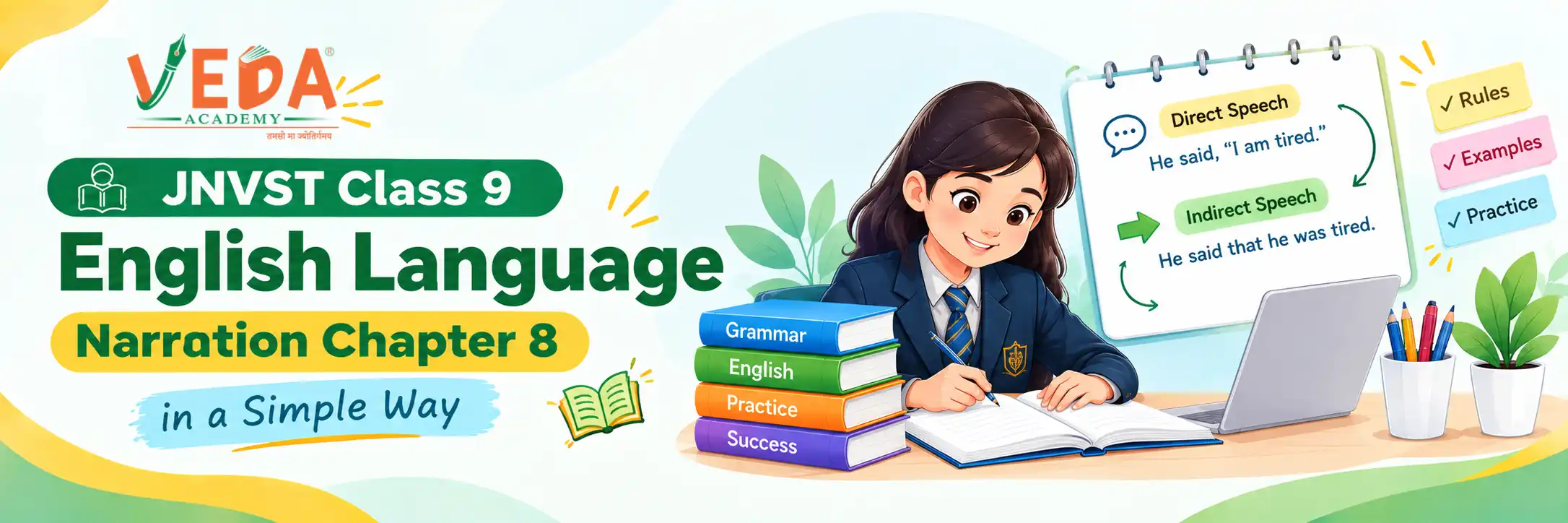
JNVST Class 9 English Language Narration Chapter 8 in a Simple Way
Have you ever told your friend what your teacher said in class? If yes, you have already used narration! It may sound like a difficult grammar topic at first, but with simple rules and regular practice, it becomes much easier. JNVST Class 9 English Language Narration helps students learn how to change direct speech into indirect speech and report someone’s words correctly.
For example, a person may say, “I am happy.” We can report these words as, “He said that he was happy.” Here, the words, tense, and pronouns change. Therefore, students need to understand these changes before solving narration questions.
Moreover, narration is an important part of English grammar for JNVST Class 9 preparation. Learning it step by step can help students improve sentence formation, grammar skills, and exam confidence. Regular practice can also help them solve questions faster and with fewer mistakes.
To make learning easier, Veda Academy provides structured Navodaya Class 9 online coaching and study material prepared according to the JNV syllabus. With simple explanations, practice questions such as JNVST Mock test, model papers, important questions, and Notes, and revision support, Veda Academy helps students understand important English topics without making learning stressful. So, if you are looking for Veda Academy English classes for Navodaya, start learning narration with clear concepts and regular practice.
What is Narration?
Narration means reporting the words spoken by a person. In English Grammar, narration has two forms, which are as follows:
Direct Speech: It refers to the exact words of the speaker.
Indirect Speech: It refers to the speaker’s words, but not the exact words.
Thus, the examples for direct & indirect narration are as follows:
Direct Speech: Yash said, "I am hungry all the time.” Indirect Speech: Yash said that he was hungry all the time. Therefore, the meaning of the sentences remains the same, but the formation of the sentence changes. Direct speech uses inverted commas. It shows the exact words spoken by someone. On the other hand, indirect speech reports the message in a different sentence form. Students preparing for JNVST Class 9 English Language should learn both forms carefully. In addition, they should practise changing direct speech into indirect speech and vice versa.
Narration PDF
Do You Need Help With Your Homework
Main Rules of JNVST Class 9 English Narration
In Navodaya Class 9 English Narration, students preparing for it must be aware of these rules, which help in solving the JNVST Class 9 English Narration questions. The rules are as follows:
Remove the quotation marks in indirect speech.
Change the pronoun when needed.
Change the tense when the reporting verb is in the past.
Change words that show time and place.
Use suitable joining words such as "that," "if," "whether," and "to."
Importance of Change in Tenses
Tense changes are important in JNVST Class 9 English Language Narration. When the reporting verb is in the past tense, the tense of the reported speech may change.
The examples for Direct & Indirect Speech are as follows: Direct Speech: Yash said, “I can sleep anywhere." Indirect Speech: Yash said that he could sleep anywhere. However, some facts and universal truths do not change their tense. Therefore, students should understand the meaning of the sentence before making a change. Pronouns can also change in indirect speech. The change depends on the speaker and the person being spoken to. The examples are as follows: Direct Speech: Riya, “I like music.” Indirect Speech: Riya said that she liked music. Similarly, “my” may become “his” or “her” based on the speaker. Hence, students should check the subject before changing a pronoun. Time and place words may also change in indirect speech. Some common changes are now → then today → that day tomorrow → the next day yesterday → the previous day here → there this → that these → those For instance, below: Direct Speech: Mohan said, “I will come tomorrow.” Indirect Speech: Mohan said that he would come the next day. As a result, learning these common changes makes JNVST Class 9 English Language Narration easier. Questions also follow special rules. In indirect speech, the question form changes into a statement form. For example: Direct Speech: He said to me, “Are you ready?” Indirect Speech: He asked me if I was ready. For questions beginning with what, where, why, when, who, or how, the question word is usually kept. Direct Speech: She said, “Where do you live?” Indirect Speech: She asked where I lived. Therefore, students should practise different types of questions. It will help the students score well in the JNVST exams. Commands, orders, advice, and requests use reporting verbs such as "ordered," "requested," "advised," and "told." For example: Direct Speech: The teacher said to Ravi, “Open your book.” Indirect Speech: The teacher told Ravi to open his book. Similarly: Direct Speech: She said, “Please help me.” Indirect Speech: She requested me to help her. These patterns are useful for solving JNVST Class 9 important questions. There are various points that students can apply while preparing for the JNVST Class 9 English Narration. First, learn the basic rules. Next, understand tense and pronoun changes. Then, practise short sentences every day. Also, solve questions based on statements, questions, commands, and requests. Students should also revise common grammar rules before the exam. Moreover, solving practice sets can improve speed and confidence. Veda Academy English classes for Navodaya can help students build these skills with simple explanations and regular practice. The learning material is prepared according to the JNV syllabus. As a result, students can study important topics in a clear and organised way. Veda Academy provides Navodaya Class 9 online coaching with useful study resources for entrance exam preparation. The platform focuses on simple teaching, practice, revision, and exam-based learning. The study material includes lessons, practice questions, revision resources, and other learning support. Furthermore, the content is prepared according to the JNV syllabus. Students looking for the best online classes for Navodaya Class 9 can use Veda Academy to study English and other important subjects from home. In addition, Veda Academy English classes for Navodaya help learners understand grammar topics step by step. With the right guidance and regular practice, students can prepare more confidently for the JNVST Class 9 exam. JNVST Class 9 English Language Narration becomes easier when students practise regularly. Therefore, students should write examples, learn common rules, and solve practice questions every day. Most importantly, do not try to learn every rule at once. Start with direct and indirect speech. Then, learn tense, pronoun, time-word, question, command, and request changes. With Veda Academy’s structured study material and Navodaya Class 9 online coaching, students can revise important English topics and prepare in a simple way.Importance of Change of Pronouns
Importance of Change in Time
JNVST Class 9 English Narration
Narration of Commands and Requests
How to Prepare for JNVST Class 9 Narration
Why Choose Veda Academy?
Practice Makes Narration Easy