 Veda Store

- Navodaya Vidyalaya Notes
- JNVST Mathematics Notes class 9
Simple and Compound Interest
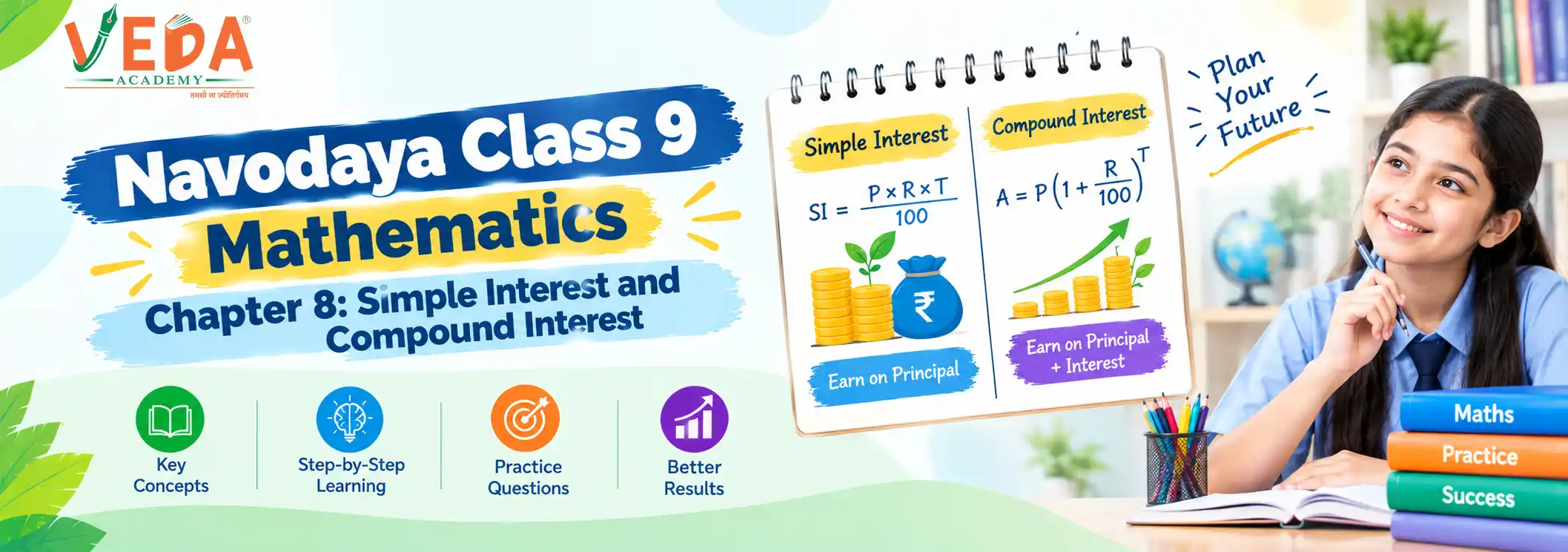
Navodaya Class 9 Mathematics Chapter 8: Simple Interest and Compound Interest with Key Formulas and Easy Explanation
Simple Interest and Compound Interest are important topics in Class 9 Maths. They help students understand how money grows over time. Therefore, students should learn the basic terms, formulas, and steps before solving questions. This guide explains Navodaya Class 9 Maths Simple Interest and Compound Interest in simple language with key formulas, examples, and easy preparation tips.
For JNV Class 9 preparation, regular practice is also important. Students can use notes, important questions, model papers, PYQs, and mock tests to revise concepts and practise different question types. These resources can also help improve calculation speed and accuracy.
Veda Academy provides useful learning support for Navodaya exam preparation. Students can access study resources such as notes, important questions, model papers, mock tests, PYQs, live and recorded classes, and doubt support. As a result, students can build strong concepts and practise regularly for the JNV Class 9 exam.
What Are Simple Interest and Compound Interest?
Simple Interest and Compound Interest show the extra money earned or paid on a principal amount. Simple interest is calculated only on the original amount. However, compound interest is calculated on the original amount plus the interest already added.
For example, if you save money in a bank, the bank may give you interest. On the other hand, if you take a loan, you may need to pay interest.
Thus, Navodaya Class 9 Mathematics Simple Interest and Compound Interest helps students understand many real-life money problems.
Also Check: Navodaya Class 9 Syllabus 2027 Subject-Wise Complete Syllabus
Simple and Compound Interest PDF
Do You Need Help With Your Homework
Simple Interest
Class 9 Maths Simple Interest is easy to understand when you know three main values:
Principal (P): The original money.
Rate (R): Interest rate per year.
Time (T): Time for which money is used.
The Simple Interest Formula is:
SI = (P × R × T) / 100
For example, if P = ₹2,000, R = 5%, and T = 2 years:
SI = (2000 × 5 × 2) / 100 = ₹200.
Therefore, the simple interest is ₹200. The Simple Interest Formula is useful when the interest stays based on the original principal. Also, students should write the values clearly before solving a question. Class 9 Maths Compound Interest works in a different way. Here, interest gets added to the amount after each period. Then, the next interest is calculated on the new amount. The Compound Interest Formula is: A = P(1 + R/100)^T Here, A means the final amount. Then: CI = A − P For example, take P = ₹1,000, R = 10%, and T = 2 years. The amount becomes ₹1,210. So, the compound interest is ₹210. The Compound Interest Formula helps students solve growth-based money questions. Moreover, it is important to check the time and rate before starting. For quick revision, learn these formulas that are mention below: The Simple Interest Formula and Compound Interest Formula should be practiced with different values. Also, check whether the question asks for interest or the total amount. First, learn the meaning of P, R, T, SI, CI, and A. Next, write the correct formula. Then, put the values into the formula. Finally, check the answer and its unit. Students preparing Navodaya Class 9 Mathematics Simple Interest and Compound Interest should solve different types of questions. In addition, revision notes and model papers can help students find common question patterns. Regular practice makes Simple Interest and Compound Interest easier. Therefore, solve a few questions every day and review your mistakes. For structured preparation, students can also explore Veda Academy resources. Its learning support can include notes, important questions, model papers, mock tests, previous-year questions, live classes, recorded classes, and doubt support. Click Here: To Enroll in Class 9 JNVST Preparation ClassesCompound Interest
Key Formulas for Navodaya Class 9 Maths Simple Interest and Compound Interest
Tips for Navodaya Class 9 Maths Preparation