 Veda Store

- Navodaya Vidyalaya Notes
- JNVST Mathematics Notes class 9
Surface Area and Volume
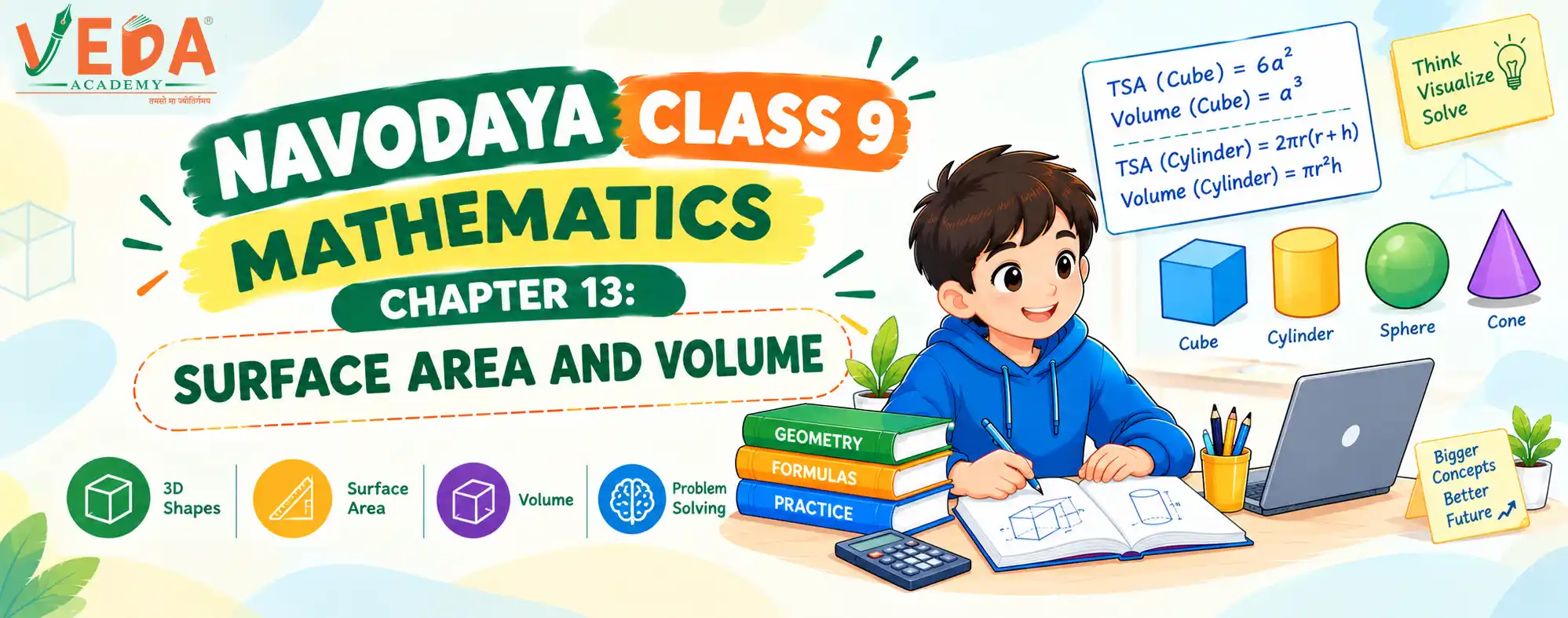
Chapter 13: Navodaya Class 9 Mathematics Surface Area and Volume
Have you ever wondered how much water a tank can hold? Or how much paper is needed to cover a box? These questions are related to Surface Area and Volume. This chapter makes such daily-life questions easy to understand.
In Navodaya Class 9 mathematics Surface Area and Volume is an important topic. It helps students learn about the space inside a solid shape and the area around it. Moreover, students learn how to use simple formulas for cubes, cuboids, cylinders, and other shapes.
Therefore, students should understand the basic ideas of Surface Area and Volume before solving exam questions. With regular practice, they can improve their speed and accuracy. Moreover, students should understand the basic rules and practise different types of questions. With regular practice, JNVST Class 9 Mathematics Surface Area and Volume can become an easy and scoring topic. Hereby, Veda Academy provides the best online classes for Navodaya Class 9 with easy-to-understand study material, such as the JNV Mock Tests, Notes, Model papers, and PYQs.
Surface Area and Volume PDF
Do You Need Help With Your Homework
What Is Surface Area and Volume?
Surface Area and Volume are two different measurements. Surface area tells us how much space the outer surface of a solid covers. For example, the surface area of a box tells us the total area of all its faces. Volume tells us how much space a solid object takes up. For example, the volume of a water tank tells us how much water it can hold. Thus, Surface Area and Volume help us understand the size and space of solid objects.
Important Formulas for Surface Area and Volume
Students preparing for JNVST Class 9 Maths Surface Area and Volume should learn the basic formulas. These formulas make questions easier and faster.
Cuboid
Total Surface Area = 2(lb + bh + hl)
Lateral Surface Area = 2h(l + b)
Volume = l × b × h
Here, l means length, b means breadth, and h means height.
Cube Total Surface Area = 6a² Lateral Surface Area = 4a² Volume = a³ Here, a means the side of the cube. Cylinder Curved Surface Area = 2πrh Total Surface Area = 2πr(r + h) Volume = πr²h Here, r means radius and h means height. Cone Curved Surface Area = πrl Total Surface Area = πr(l + r) Volume = 1/3 πr²h Here, l means slant height. Sphere Surface Area = 4πr² Volume = 4/3πr³ These formulas are useful for many Surface Area and Volume questions. Also Check: How to Download Navodaya Class 9 Admit Card 2027 Online The JNV Syllabus includes important concepts that students should study step by step. In addition, students should solve questions from different difficulty levels. For Navodaya Class 9 mathematics Surface Area and Volume, students can follow these simple steps: Learn the basic concepts. Write important formulas in a notebook. Understand solved examples. Practise easy questions first. Move to word problems. Revise formulas every week. Take mock tests regularly. Learn one formula at a time. Draw the shape when needed. Write all measurements clearly. Check whether the question asks for area or volume. Use the correct unit. Practise word problems. Revise mistakes after every test. Furthermore, students should focus on both speed and accuracy. This approach can make Navodaya Class 9 Mathematics Surface Area and Volume easier to solve in an entrance exam. Moreover, they should not try to memorise every question. Instead, they should understand the method. Once the method becomes clear, many Surface Area and Volume problems become easier. Also Check: Navodaya Class 9 Syllabus 2027 Subject-Wise Complete Syllabus Regular practice is the key to mastering Navodaya Class 9 Mathematics Surface Area and Volume. Students should solve a few questions every day. They should also revise difficult questions after a test. With Veda Academy JNVST Class 9 preparation, students can follow a planned learning routine. The available resources can support concept learning, revision, and exam practice. In addition, students preparing through the Best online classes for JNV Class 9 exam preparation can make a daily timetable. They can give extra time to topics that need more practice. Thus, steady practice can build confidence and improve problem-solving skills. Click Here: To Enroll in Class 9 JNVST Preparation Classes Preparing for JNVST requires the right study material and regular practice. Veda Academy JNVST Class 9 preparation is designed to support students with structured learning resources. Veda Academy provides study materials prepared according to the JNV Syllabus. These resources can help students understand difficult topics in a simple way. Students can use the various resources mentioned below: Chapter-wise study material Easy-to-understand notes Important formulas Practice questions Previous-year question practice Mock tests Revision resources Online learning support For students looking for the Best coaching for Navodaya Class 9 exam preparation, Veda Academy offers a focused online learning approach. Students can study from home and revise topics at their own pace. Similarly, students searching for the Best online classes for JNV Class 9 exam preparation can use Veda Academy's learning resources for regular practice. The goal is simple: understand the concept, practise questions, revise regularly, and improve performance.14 Tips to Prepare for JNVST Class 9 Maths Surface Area and Volume
Practice Makes Surface Area and Volume Easy
Study with Veda Academy, the Best coaching for Navodaya Class 9 exam preparation