 Veda Store

- Navodaya Vidyalaya Notes
- JNVST Class 6 EVS Notes
Chapter 1 Transportation
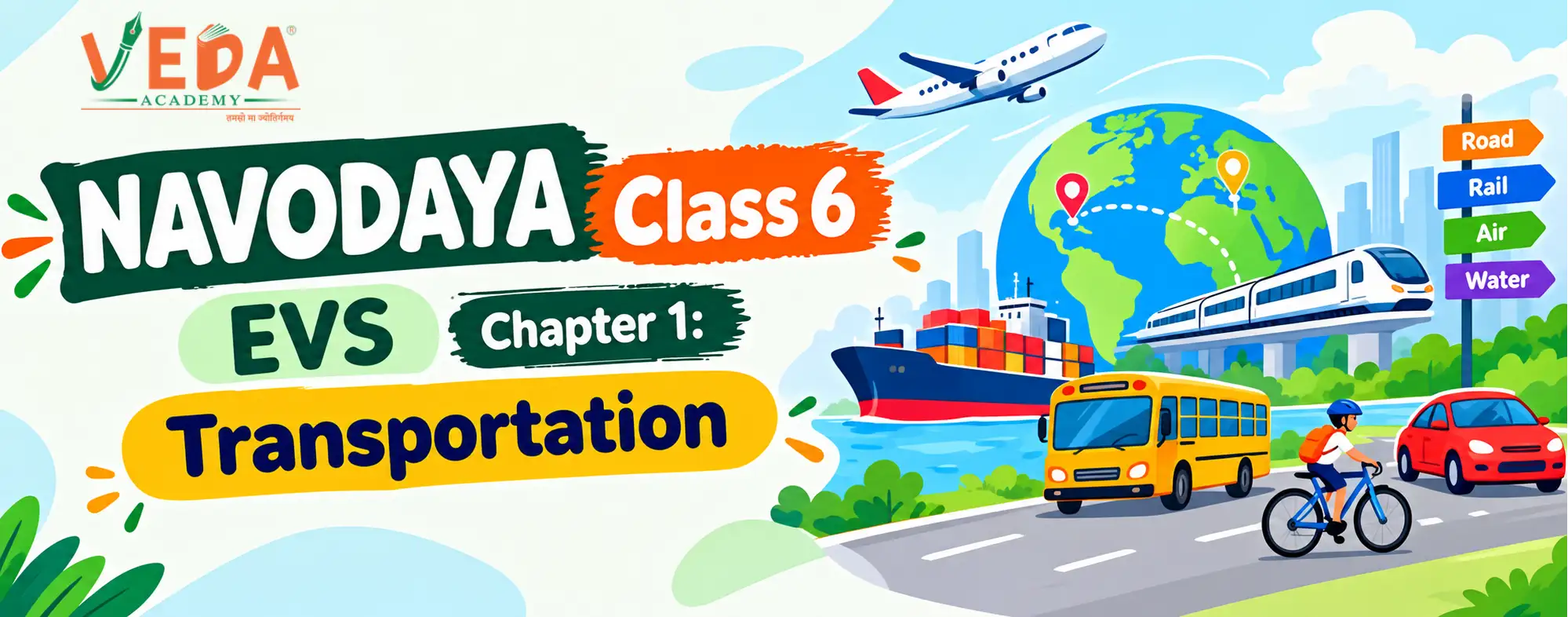
Navodaya Class 6 EVS Chapter 1 Transportation
As per the JNV syllabus, Navodaya Class 6 EVS Chapter 1 Transportation is an important topic for students preparing for the Navodaya Class 6 entrance exam. Transportation helps us move from one place to another. Navodaya Class 6 EVS Chapter 1 Transportation also helps us carry people and goods. Therefore, students should understand the basic ideas of transportation and its types.
The Transportation Class 6 EVS topic can be easy to learn with simple examples. For example, we use buses, cars, trains, boats, and aeroplanes in our daily lives. Each vehicle is useful for a different purpose. So, learning about them can help students answer EVS questions with more confidence.
What Is Transportation?
According to the Navodaya Class 6 EVS Chapter 1 Transportation, Transportation means moving people or things from one place to another. It is an important part of our daily life. We use different vehicles for travel. We also use them to move food, clothes, books, machines, and other goods.
For example, a bus takes people to school or work. A truck carries goods from one city to another. Similarly, a train can carry many people over a long distance. Thus, transportation makes travel easier and faster. It also helps people stay connected with different places. Navodaya Class 6 EVS Chapter 1 Transportation is important for many reasons. First, transportation helps people travel from one place to another. Second, it helps move goods between villages, towns, and cities. As a result, people can get the things they need. Transportation also helps farmers, workers, students, and business owners. For example, farmers can send their crops to markets. Students can travel to school by bus or other vehicles. Moreover, transportation saves time. In the past, people often walked long distances. Today, different vehicles make travel much easier. There are different types of transportation. They are mainly divided into three groups: Land transportation Water transportation Air transportation Each type has its own use. Therefore, students should learn the main examples of each type. Land Transportation Land transportation is used on roads and railway tracks. It is one of the most common types of transportation. Some common examples are: Bus Car Bicycle Auto-rickshaw Motorcycle Truck Train Buses and cars are used for road travel. On the other hand, trains run on railway tracks. Trucks are mainly used to carry goods. Therefore, land transportation is very useful for short and long-distance travel. Water Transportation Water transportation is used on rivers, lakes, seas, and oceans. It is useful for carrying people and goods across water. Some examples include: Boat Ship Ferry Steamer Boats can be used on rivers and lakes. Ships can travel across seas and oceans. In addition, large ships can carry many goods from one country to another. So, water transportation is very important for trade and travel. Air Transportation Air transportation is used to travel through the air. It is usually the fastest way to travel long distances. Some examples are: Aeroplane Helicopter Aeroplanes can carry many passengers. Helicopters can land in places where large aeroplanes cannot. Therefore, air transportation is useful in many situations. For example, people can use aeroplanes to travel between far-away cities in a short time. Transportation in Daily Life We use transportation almost every day. Students may use a school bus, bicycle, car, or auto-rickshaw to reach school. Parents may use buses, trains, or other vehicles to travel to work. Similarly, shops need transportation to receive goods. Farmers need vehicles to take crops to markets. Therefore, transportation is connected to many parts of our lives. The Navodaya Class 6 Transportation topic also helps students understand how people and goods move from one place to another. Public and Private Transportation Transportation can also be grouped as public and private transportation. Public transportation is used by many people. For example, buses and trains are common forms of public transportation. They can carry many passengers at the same time. Private transportation is usually used by an individual or a family. For example, a personal car, bicycle, or motorcycle can be a private vehicle. Both types are useful. However, public transportation can help many people travel together. Transportation has changed a lot over time. In the past, people mainly walked or used animals for travel. Bullock carts, horses, and boats were common means of transportation. Later, new vehicles were developed. Buses, cars, trains, ships, and aeroplanes made travel faster. Today, modern vehicles help people travel long distances in less time. As a result, transportation has made communication and travel easier. Transportation is useful, but some vehicles can cause pollution. Vehicles that use petrol or diesel can release harmful gases. These gases can affect air quality. Therefore, we should use transportation carefully. Walking and cycling are good choices for short distances. Public transport can also reduce the number of vehicles on roads. Students should learn that we need transportation. At the same time, we should also care for our environment. The following points can help students revise the chapter: Transportation means moving people or goods from one place to another. Land transportation includes buses, cars, bicycles, trucks, and trains. Water transportation includes boats, ships, and ferries. Air transportation includes aeroplanes and helicopters. Buses and trains are common examples of public transportation. Cars and bicycles can be examples of private transportation. Transportation makes travel easier and faster. Some vehicles can cause air pollution. Walking and cycling are useful for short distances. Public transport can help reduce the number of vehicles on roads.Why Is Transportation Important?
Types of Transportation
How Has Transportation Changed?
Transportation and the Environment
Important Points to Remember
Chapter 1 Transportation PDF
Do You Need Help With Your Homework
Students should study the topic in small parts. First, understand the meaning of transportation. Next, learn the three main types of transportation. Then, remember common examples of each type. After that, practise simple questions. For example, students can ask themselves which vehicles travel on land, water, or air. Regular revision is also helpful. Students can make short notes and revise them before a test. Moreover, practice questions can help students check their understanding. The Navodaya Class 6 EVS Transportation topic can become easier when students connect each concept with examples from daily life. Students who need extra help can choose best coaching for navodaya vidyalaya class 6 exam preparation. Good guidance can help students understand topics and follow a proper study plan. Veda Academy provides learning resources for students preparing for the Navodaya Class 6 entrance exam. Students can use notes, important questions, model papers, mock tests, and previous year questions for regular practice. Students can also look for best online classes for navodaya vidyalaya class 6 exam preparation when they need guided learning from home. Online classes can help students learn difficult topics, revise lessons, and practise questions regularly. With proper study, regular practice, and the right guidance, students can prepare for the Navodaya Class 6 exam with greater confidence. Navodaya Class 6 EVS Chapter 1 Transportation teaches students about the different ways people and goods move from one place to another. Land, water, and air transportation are the main types. Therefore, students should learn the examples and uses of each type. They should also understand how transportation affects daily life and the environment. Finally, regular revision and practice can make Transportation Class 6 EVS easier to understand. With a simple study plan and regular practice, students can improve their EVS preparation for the Navodaya entrance exam.How to Prepare Transportation for Navodaya Class 6 Exam Preparation?
Join Veda Academy for Class 6 Navodaya Exam Preparation
Wrapping Up