 Veda Store

- Navodaya Vidyalaya Notes
- JNVST Class 6 EVS Notes
EVS Chapter 6
Navodaya Class 6 EVS Chapter 6: Water Cycle for JNVST Preparation
According to the Class 6 Navodaya Syllabus, the Navodaya Class 6 EVS Chapter 6 Water Cycle is an important topic for students preparing for the JNVST exam. Water is found in rivers, lakes, ponds, oceans, and the ground. However, water does not stay in one place. Instead, it keeps moving from the Earth to the sky and back again. This process is called the water cycle.
The Navodaya Class 6 Water Cycle is easy to learn when students understand each step. Therefore, students should learn the process in the correct order.
What Is the Water Cycle?
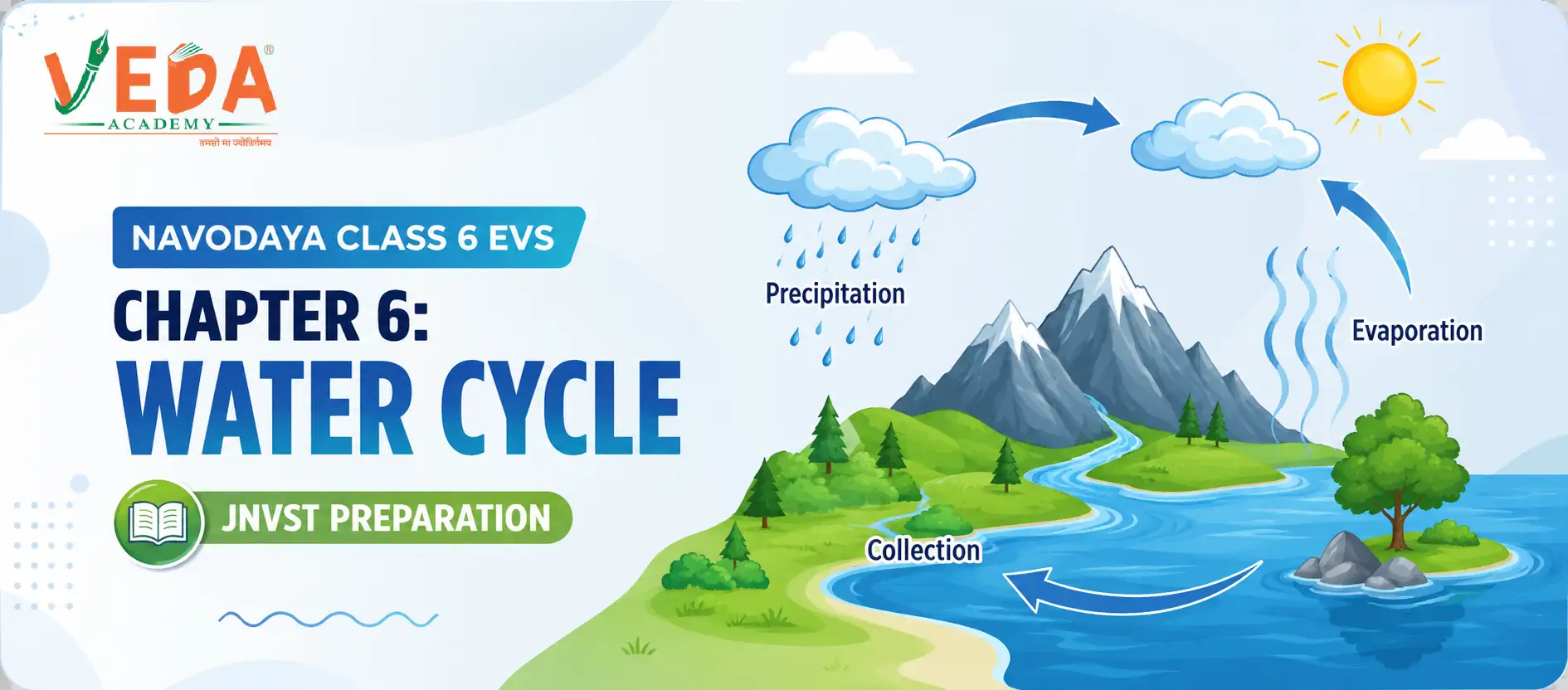
The water cycle is the continuous movement of water in nature. The sun gives heat to water on Earth. As a result, water changes into water vapour and rises into the air. Later, the vapour cools and forms clouds. Then, water falls back to Earth as rain.
The Navodaya Class 6 EVS Water Cycle mainly includes evaporation, condensation, precipitation, and collection. So, learning these four steps can make the topic simple. For quick revision, students can use the Navodaya Class 6 Water Cycle PDF. It can help them read the topic again and remember the main points. Read more: Top 3 Navodaya Class 6 Entrance Exam Preparation Book for 2027 Exam 1. Evaporation : First, the sun heats water in oceans, rivers, lakes, and ponds. Then, some water changes into water vapour. This vapour rises into the air. This step is called evaporation. For example, wet clothes become dry when kept in the sun. This happens because water changes into vapour. The Navodaya Class 6 Water Cycle starts with this important step. Therefore, students should understand evaporation clearly. 2. Condensation : Next, water vapour rises higher into the sky. The air is cooler there. So, the vapour cools down and changes into tiny water drops. These drops join together and form clouds. This process is called condensation. Thus, condensation helps in cloud formation. In the Navodaya Class 6 EVS Chapter 6 Water Cycle, condensation is an important point to remember. Students may also see simple questions about cloud formation in their practice work. 3. Precipitation : After that, clouds become full of water drops. When the drops become heavy, they fall towards the Earth. This is called precipitation.Rain is the most common form of precipitation. However, snow and hail can also be forms of precipitation in some places. The Navodaya Class 6 EVS Water Cycle becomes easier when students connect clouds with rainfall. Therefore, remember that precipitation brings water back to the Earth. 4. Collection : Finally, water collects on the Earth. It fills rivers, lakes, ponds, and oceans. Some water also goes into the soil. Then, the water cycle starts again. So, the Navodaya Class 6 EVS Chapter 6 Water Cycle is a continuous process. Water keeps moving through different stages.Steps of the Water Cycle
EVS Chapter 6 PDF
Do You Need Help With Your Homework
The water cycle helps provide fresh water to living things. Plants need water to grow. Animals need water to live. People also need water for drinking, cooking, farming, and cleaning. Moreover, the water cycle helps maintain water in nature. Without this natural process, many living things would face problems. The Navodaya Class 6 Water Cycle PDF can help students revise these points before the JNVST exam. Also, students can make short notes from the chapter. Students can remember the process with this simple order: Sun heats water - Evaporation - Condensation - Clouds - Precipitation - Collection This simple chain makes the Navodaya Class 6 Water Cycle easy to remember. In addition, students should draw the cycle in their notebook. A simple diagram can make revision faster. The Navodaya Class 6 EVS Chapter 6 Water Cycle may also include questions about daily-life examples. Therefore, try to connect each step with things you see around you. Students can use a Navodaya Class 6 Water Cycle PDF for quick revision. It can include simple explanations, key points, and practice questions. As a result, students can revise the chapter without reading long notes. Also, the Navodaya Class 6 EVS Water Cycle can be revised through short questions. For example, students can ask themselves what evaporation means, how clouds form, and what precipitation is. Regular revision can make the Navodaya Class 6 EVS Chapter 6 Water Cycle easier to remember. Thus, students should revise the topic after learning it. Good guidance can make exam preparation easier. Students who need regular support can look for the best coaching for Navodaya Vidyalaya Class 6 exam preparation. A good learning plan can help students study EVS and other subjects step by step. Similarly, the best online classes for Navodaya Vidyalaya Class 6 JNVST preparation can help students learn from home. Live classes, recorded lessons, notes, and practice tests can support regular study. Veda Academy provides learning resources, such as notes, important questions, model papers, and PYQs for students preparing for JNVST Class 6. Students can use study materials and practice resources for better preparation. They can also join courses for structured learning.Why Is the Water Cycle Important?
Easy Way to Remember the Water Cycle
Prepare With the Navodaya Class 6 Water Cycle PDF
Why Choose Veda Academy for Navodaya Exam Preparation?