 Veda Store

- Sainik School Notes
- AISSEE Language Notes class 6
CH-2 Pronoun
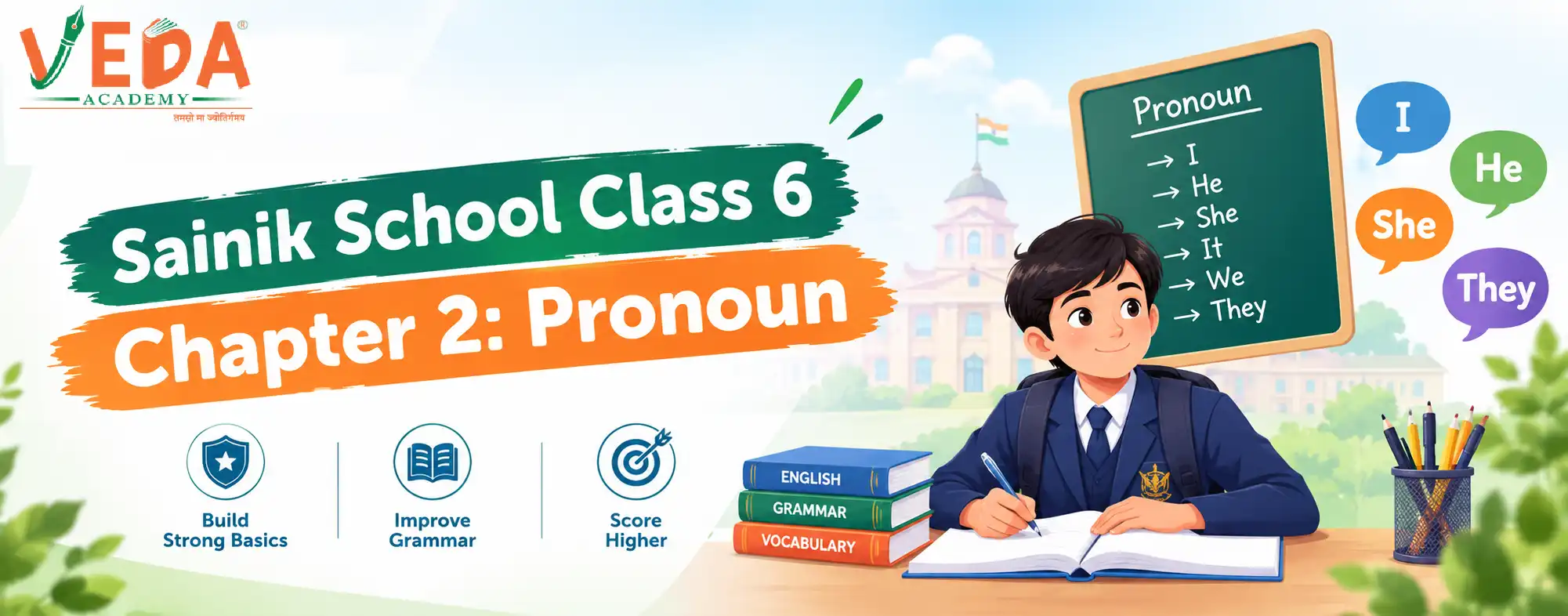
Chapter 2: Sainik School Class 6 English Pronouns Simple Explanation
Imagine saying, "Yash is a good student. Yash studies every day. Yash loves reading.” Doesn’t it sound awkward? Now here’s a better way to say it: "Yash is a good student. “He” is in college. "He” loves reading.”
Now the sentences are smoother, as we used english pronouns to make them more concise. Pronouns make our sentences short, clear, and easy to understand. Therefore, they are an important part of English grammar. If you are preparing for the Sainik School Class 6 entrance exam, this guide will help you learn pronouns with simple examples and practice questions. Moreover, with Veda Academy’s learning resources, students can practise from the study material offered by them, such as Class 6 Sainik School Pronouns Notes, mock tests, important questions, PYQs, and model papers.
CH-2 Pronoun PDF
Do You Need Help With Your Homework
What are pronouns?
A pronoun is a word that we use instead of a noun. It helps us avoid repeating the same name or word again and again. Examples are as follows:
Rahul is my friend. He is kind.
This is my book. It is new.
Riya and Tina are sisters. “They” study together.
Amit and I play cricket. “We” play every Sunday.
Here, “he, it, they,” and “we” are pronouns. Learning Sainik School Class 6 English Pronouns helps students write better sentences and understand basic grammar rules.
Also Check: How to Fill Sainik School Class 6 Admission Form 2027-28 Step-by-Step Online Application Guide There are several types of Sainik School Class 6 English pronouns. Let us learn the main types with easy examples. Personal Pronouns: Personal pronouns refer to people or things. They include “I, we, you, he, she, it and they." The examples are as follows: “I” am a student. “You” are my friend. “He” plays football. “She” sings well. “It” is a red ball. “We” study together. “They” are happy. Remember, we use “he” for a boy or man and “she” for a girl or woman. We usually use “it” for an animal or thing when its gender is not specified. Possessive Pronouns: Possessive pronouns show that something belongs to someone. Examples include “mine, yours, his, hers, ours, and *theirs.” This pen is “mine”. That bag is “yours”. The red bicycle is “hers”. This classroom is “ours”. The toys are “theirs.” For example, “This is my book” uses a possessive word before a noun. However, “This book is mine” uses a possessive pronoun. Demonstrative Pronouns: Demonstrative pronouns point to a person or thing. The four main demonstrative pronouns are “this," "that," "these," and “those.” Therefore, remember that “this” and “that” refer to one thing. On the other hand, “these” and “those” refer to more than one. Interrogative Pronouns: Interrogative pronouns help us ask questions. They include who, whom, whose, what, and which. The Examples are as follows: Who is your teacher? Whom did you call? Whose is this bag? What is your name? Which is your favourite subject? These pronouns help us ask about people, things, and ownership. Moreover, they make questions easier to form. Reflexive Pronouns: Reflexive pronouns refer back to the person or thing doing the action. Examples include "myself," "yourself," "himself," "herself," "itself," "ourself," "yourselves," and "themselves." The Examples are as follows: I completed the work myself. She made the card herself. He hurt himself while playing. They cleaned the room themselves. Notice how the pronoun refers back to the subject. As a result, the sentence becomes clear. Relative Pronouns: Relative pronouns join information about a person or thing to a sentence. The common relative pronouns are who, whom, whose, which, and that. The Examples are as follows: The boy who won the race is my friend. This is the book that I bought. The girl whose bag is blue is my sister. The dog which barked is small. These words connect ideas and give us more information. Therefore, they are useful for writing longer sentences. Indefinite Pronouns: Indefinite pronouns refer to people or things without naming them exactly. Examples include someone, anyone, everyone, nobody, something, and everything. The Examples are as follows: Someone is at the door. Everyone enjoyed the game. Nobody was absent. Something is in the box. Here, we do not name the person or thing. Instead, we use an indefinite pronoun. Also Check: Sainik School Class 6 Syllabus 2027 Complete Subject-Wise Syllabus and Exam Pattern Below are a few rules of Sainik School Class 6 English Pronouns, so follow these simple rules to use pronouns correctly. Rule 1: Match the pronoun with the noun. Incorrect: Riya is my friend. He is kind. Correct: Riya is my friend. She is kind. Rule 2: Use the correct pronoun for one or more people. Aman is here. He is ready. Aman and Ravi are here. They are ready. Rule 3: Use the correct possessive pronoun. This pencil is mine. That house is theirs. Rule 4: Avoid repeating nouns. Incorrect: Mohan has a dog. Mohan loves Mohan’s dog. Correct: Mohan has a dog. He loves his dog. These rules are useful for Class 6 English Grammar Pronouns. Practise them often to avoid common mistakes. Now, test your knowledge with these multiple-choice questions. First, choose your answers. Then, check the answer key. Learning grammar becomes easier when you follow a simple study plan. Learn one type at a time. First, study personal pronouns. Then, learn the other types. Read simple examples. Notice how pronouns replace nouns in sentences. Write your own sentences. Use each type of pronoun in at least two sentences. Practise daily. Solve five to ten questions to improve your accuracy. Revise your mistakes. Write down the correct answers and learn the rules. Practice more mock tests. They help you practise answering questions within a time limit. Also Check: Subject Wise Sainik School Class 6 Notes for Entrance Exam Preparation 2027 With Veda Academy, students can explore useful study materials and practise important concepts for the Sainik School entrance exam. Moreover, consistent revision and regular question-solving can help learners identify their weaknesses and improve their performance. Whether you are studying Sainik School Class 6 English Grammar, Mathematics, or Science, focus on understanding the concepts before moving to advanced questions. Combine quality study materials with a daily timetable and regular practice to prepare more effectively for the entrance examination. Start your preparation with Veda Academy and take a confident step towards your Sainik School admission goal. Pronouns help us avoid repeated words and make sentences clearer. Therefore, learning their types and rules is an important step in improving English grammar. This Sainik School Class 6 English Pronouns guide gives you simple explanations, examples, and practice questions. Revise each type, practise regularly, and check your mistakes. With steady effort and suitable study materials, you can build a strong grammar foundation for your entrance exam.Types of Pronouns for Sainik School Class 6
Important English Pronouns Rules for Class 6
Sainik School Class 6 Pronouns Practice Questions
How to Prepare Pronouns for the Sainik School Entrance Exam
Veda Academy, the Best Online Classes for Sainik School Entrance Exam Preparation
Wrapping Up