 Veda Store

- Navodaya Vidyalaya Notes
- JNVST Class 6 EVS Notes
EVS Chapter 17
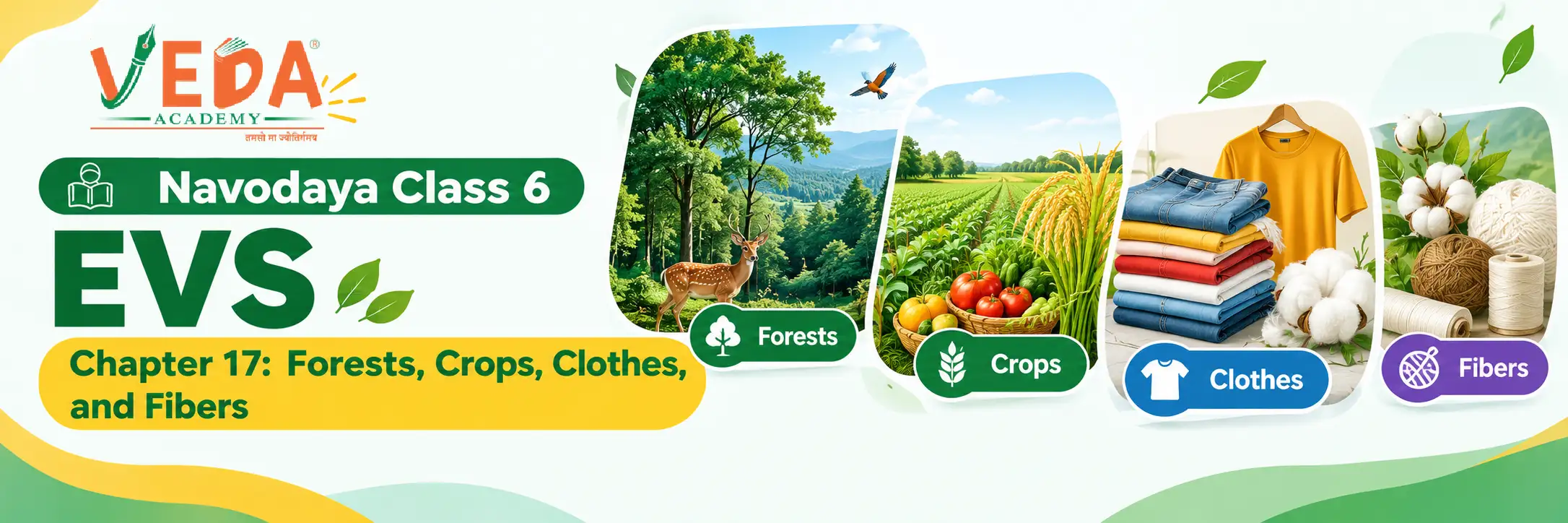
Navodaya Class 6 EVS Chapter 17: Forests, Crops, Clothes, and Fibers
Navodaya Class 6 EVS Forests, Crops, Clothes, and Fibers helps students learn about forests, crops, plants, clothes, and natural fibres. This chapter connects nature with our daily life. For example, we get food from crops and many clothes from plant fibres. At the same time, forests give us food, wood, medicines, and fresh air.
Therefore, students should understand how plants and forests support people and animals. Navodaya Class 6 EVS Forests, Crops, Clothes, and Fibers also teaches students why we should protect natural resources. Therefore, Veda Academy is a platform that provides Navodaya Class 6 EVS Forests, Crops, Clothes, and Fibers study material, such as JNV Notes, important questions, model papers, and Mock Tests.
What Will You Learn in Navodaya Class 6 EVS Chapter 17?
Navodaya Class 6 EVS Chapter 17 introduces many useful ideas in a simple way. First, students learn about forests and the plants found there. Next, they explore different crops grown by farmers. Then, they learn how plants provide fibres that we use to make clothes.
Moreover, the chapter helps students understand the connection between plants, food, clothes, and human life. Navodaya Class 6 EVS Forests, Crops, Clothes, and Fibers makes these ideas easy to understand with familiar examples.
Importance of Forests, Crops, Clothes, and Fibers
Forests are large areas covered with trees, plants, shrubs, and grasses. They are also home to many birds, insects, and wild animals. In addition, forests help keep the air clean and support the water cycle. People get many useful things from forests. These include fruits, honey, wood, herbs, gum, and bamboo. However, cutting too many trees can harm forests. It can also destroy animal homes.
Therefore, we must use forest resources carefully. Planting trees and protecting existing forests can help keep nature healthy. Navodaya Class 6 EVS Forests, Crops, Clothes, and Fibers explains why forests are important for both people and animals.
Understanding Different Crops
Crops are plants that farmers grow for food and other uses. Rice, wheat, maize, pulses, cotton, sugarcane, and vegetables are common crops. However, different crops need different weather, soil, and water.
For example, farmers grow rice mainly in areas with plenty of water. Wheat grows well in cooler weather. Similarly, cotton grows well in warm areas. Farmers prepare the soil before planting seeds. Then, they water the crops and protect them from weeds and pests. Finally, they harvest the crops when they are ready. Navodaya Class 6 EVS Forests, Crops, Clothes, and Fibers helps students understand why crops are important in our daily lives.
EVS Chapter 17 PDF
Do You Need Help With Your Homework
How do we get clothes?
Have you ever wondered where some of your clothes come from? Many clothes are made from fibres that come from plants. Cotton is one of the most common plant fibres.
Cotton grows around the seeds of the cotton plant. After farmers collect cotton, it goes through several steps. First, seeds are removed from the cotton. Next, the cotton fibres are cleaned and spun into yarn. Finally, the yarn is woven or knitted to make cloth. In the same way, jute provides another useful plant fibre. Jute is often used to make bags, ropes, mats, and other products. Thus, Navodaya Class 6 EVS Forests, Crops, Clothes, and Fibers shows how plants become useful products.
What are Natural and Plant Fibres?
Fibres are thin strands that are easily made into yarn and cloth. Natural Fibres come from plants or animals. For example, jute and cotton are plant fibres. On the other hand, silk and wool are examples of animal fibres.
Now, when we talk about plant fibres, cotton is useful in making shirts, dresses, and clothes. On the other hand, jute is good for making bags and ropes since it is strong. Students can easily learn these examples through daily-life objects. For instance, look at a cotton shirt or a jute bag. This simple activity makes Navodaya Class 6 EVS Forests, Crops, Clothes, and Fibers more interesting.
Why should we protect Forests?
Forests are a valuable resource for the environment. They have a multipurpose role, such as providing shelter to animals and birds and providing food for them. Moreover, they help in preventing soil erosion. Furthermore, trees absorb carbon dioxide and release oxygen.
However, forests do suffer from a lot of problems. For their own benefit, people cut the trees down; forest fires, pollution, and excessive use of forest resources can damage them. As a result, the animals lose their shelter & homes, and it affects the environment and weather also. For example, due to forest fires, carbon dioxide is released into the environment, which increases global warming. Therefore, we can help protect forests in many ways. Then, we can plant trees, avoid wasting paper, and reuse useful materials. Lastly, we can raise awareness of how important forests are for human & animal survival. Through Navodaya Class 6 EVS Forests, Crops, Clothes, and Fibers, students can learn that small actions can help protect nature. Here, we are providing some of the Navodaya Class 6 EVS Important Questions that can come in the exams. The students must be aware of all types of questions that can come in JNV exams. For this, Veda Academy offers the best online classes for Navodaya Vidyalaya Class 6 and also has its own Veda Store, from where the students can easily purchase the practise papers to crack the JNV exams. Below are the Navodaya Class 6 EVS Important Questions: What is a forest? Why are forests important? What are crops? Name five common crops. What are plant fibres? How is cotton changed into cloth? What is jute used for? Why should we protect forests? What is the difference between cotton and jute? How do crops help people? First, the students need to read Navodaya Class 6 EVS Chapter 17 by Veda Academy, which provides the best coaching for Navodaya Vidyalaya Class 6, carefully. Then, make short notes about forests, crops, and fibres. Next, learn important examples such as cotton, jute, rice, and wheat. After that, practise the Navodaya Class 6 EVS important questions without looking at the answers that are prepared. Also, revise difficult words and concepts regularly. Students who want the best online classes for Navodaya Vidyalaya Class 6 can study lessons with videos, explanations, quizzes, and practice activities which are prepared according to the JNV syllabus. Online learning can make revision easier because students can study at a convenient time. Similarly, parents must opt for Veda Academy, the best coaching for Navodaya Vidyalaya Class 6, as their child needs regular guidance and structured preparation. Navodaya Class 6 EVS Forests, Crops, Clothes, and Fibers covers important ideas about nature and daily life. Forests support animals and people. Crops provide food and other useful products. Plants such as cotton and jute provide fibres for making different products. Therefore, students should learn these topics with real-life examples. Regular reading and practice can make Navodaya Class 6 EVS Forests, Crops, Clothes, and Fibers easier to understand. By revising Navodaya Class 6 EVS Chapter 17, practising Navodaya Class 6 EVS important questions, and using suitable learning support, students can build strong EVS knowledge. Most importantly, this chapter teaches a valuable lesson: nature gives us many things, so we must care for it.Navodaya Class 6 EVS Important Questions
Prepare with Veda Academy for the Best Coaching for Navodaya Vidyalaya Class 6
Quick Recap