 Veda Store

- Navodaya Vidyalaya Notes
- JNVST Science Notes class 9
Combustion and Flames
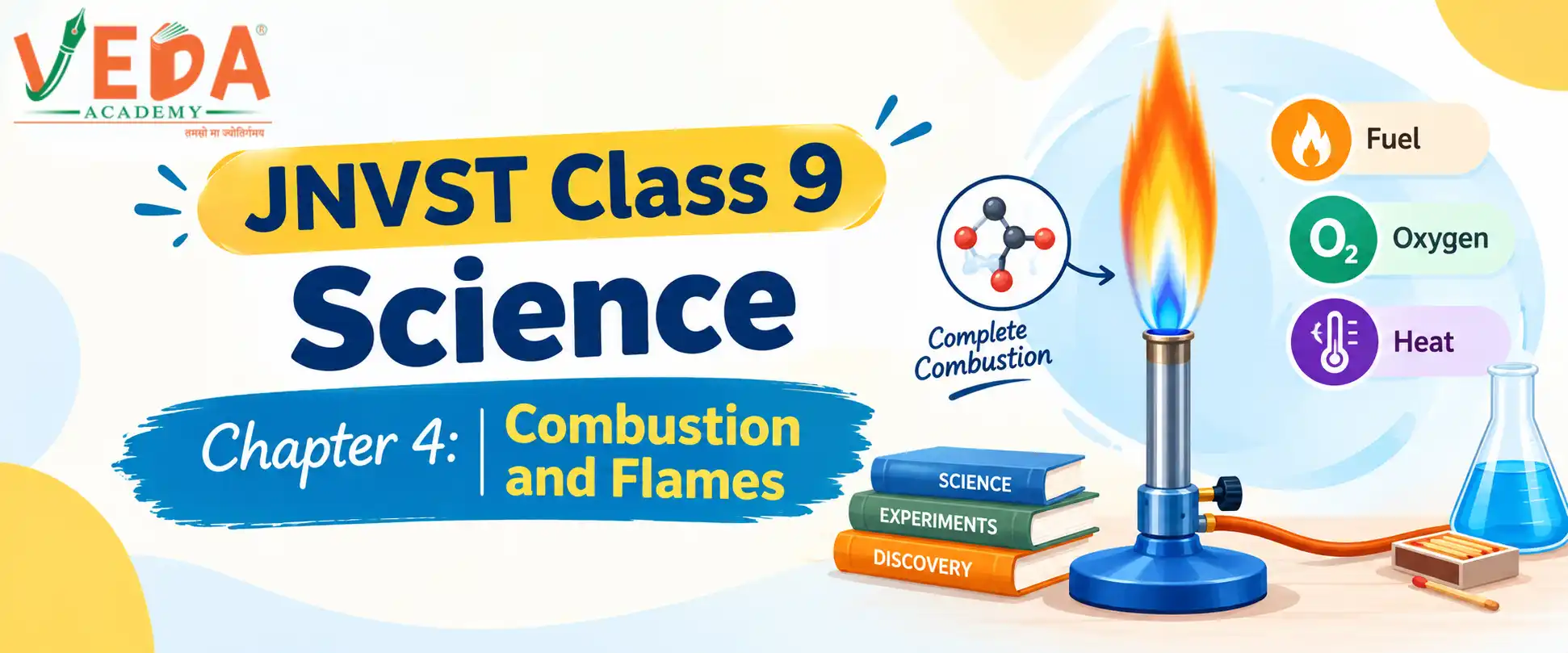
JNVST Class 9 Science Chapter 4: Combustion and Flames in a Detailed Way
Fire seems to be simple, but there is a lot of science behind it! Burning of a candle, gas stove, campfire, and even a firecracker all work on various kinds of combustion processes. JNVST Class 9 Science Combustion and Flames enables students to understand the science behind the above-mentioned burning things. This lesson is going to familiarize students with fuel, combustion, ignition temperature, flame zone, types of combustion, and fire control. Apart from that, these concepts can also enable students to answer JNVST Class 9 Science questions confidently.
For better preparation, Veda Academy offers complete learning support for Navodaya aspirants. Its JNVST Class 9 Science study material includes chapter-wise notes, important questions, practice worksheets, previous-year questions, mock tests, revision resources, and other exam-focused content. These materials are prepared according to the JNV syllabus to make learning simple and organised.
Furthermore, Veda Academy's JNV Online Classes provide easy-to-follow lessons, regular practice, revision guidance, and doubt-solving support. With Navodaya Class 9 online coaching, students can learn from home and follow a structured study plan. So, get ready to explore JNVST Class 9 Science Combustion and Flames with Veda Academy and build a strong foundation for your Navodaya Class 9 exam preparation!
What is JNVST Class 9 Science Combustion and Flame, Fuel?
Combustion is a reaction that involves oxygen in which heat energy is produced. In most cases, energy in the form of light is also produced when combustion occurs. This can be seen in the combustion of wood, where light and heat energy are produced. Nonetheless, all substances do not catch fire at the same temperatures. All substances require a certain amount of heat energy to ignite them. This particular amount of heat energy is referred to as the ignition temperature.
Consequently, in JNVST Class 9 Science Combustion and Flames, the students are able to understand why a matchstick ignites when it is rubbed on a rough surface.
Now, when we talk about flames, it is basically a physical representation of fire. It is usually seen when a substance burns in the form of a gas. For example, LPG gives a flame when it burns. However, charcoal does not usually produce a flame because it does not produce enough vapor. JNVST Class 9 Science Combustion and Flames also explains the different zones of a flame.
Simultaneously, fuel is a substance that produces heat when it burns. Wood, coal, petrol, diesel, LPG, and natural gas are common fuels. Furthermore, a good fuel should produce a large amount of heat. It should also be easy to store and transport. Besides this, it should not produce too much smoke or harmful gases.
Combustion and Flames PDF
Do You Need Help With Your Homework
Types of Combustion
JNVST Class 9 Science Combustion and Flames includes different types of combustion. Each type has a different speed and effect. We have explained them below:
Rapid Combustion: Rapid combustion happens very quickly. Producing the heat and light in no time. For example, LPG burns rapidly when it comes into contact with flames.
Slow Combustion: It takes place slowly and extinguishes after a long time. For example, the food in a human body oxidizes after a long time in the body to turn it into energy.
Spontaneous Combustion: Spontaneous combustion happens without an outside flame or spark. Some materials can catch fire on their own when enough heat builds up inside them. For example, coal dust and some oily materials may catch fire under certain conditions.
Explosion: A very fast form of combustion, producing a huge amount of heat, light, sound, and gases in a short time. Firecrackers are the best example of explosions.
Thus, JNVST Class 9 Science Combustion and Flames helps students understand these different forms of burning.
How Can Fire Be Controlled?
Fire needs 3 things fuel, oxygen, and Heat. These three parts are often called the fire triangle. If we remove any one part, the fire can stop. For example, water can cool a burning object. It reduces the heat below the ignition temperature. Sand or a fire blanket can also stop oxygen from reaching the fire.
However, water should not be used on electrical fires or oil fires. It can make such fires more dangerous. This is an important point in JNVST Class 9 Science Combustion and Flames.
What is an Ideal Fuel?
An ideal fuel has many qualities that are useful. It should have a high calorific value. It should be cheap and easily be stored. Moreover, it should be easy to transport and should not cause pollution. Therefore, students should learn these points while using JNVST Class 9 Science study material.
Calorific Value
The calorific value tells us how much heat a fuel produces when a fixed amount of it burns completely. It is usually measured in kilojoules per kilogram (kJ/kg). A fuel with a higher calorific value can produce more heat. As a result, calorific value is an important topic in JNVST Class 9 Science Combustion and Flames and may appear in JNVST Class 9 Science questions.
Harmful Effects of Burning Fuels
Burning of fuel can lead to the production of smoke and other gases. One such gas is carbon monoxide. This is because it reduces the ability of blood to transport oxygen in the body. Moreover, burning of fuel causes air pollution. Another effect of burning fuel is that some gases are emitted, such as carbon dioxide, which causes global warming.
How Veda Academy's JNV Online Classes Help Students
Good preparation needs clear concepts and regular practice. Veda Academy's JNVST Class 9 Science preparation helps students learn important topics in a simple way.
Veda Academy provides useful JNVST Class 9 Science study material prepared according to the JNV syllabus. Students can use chapter notes, practice questions, revision material, and other learning resources. Moreover, Veda Academy's JNV Online Classes help students learn from home. The lessons focus on concepts, practice, and exam needs.
Students looking for the best online classes for Navodaya Class 9 can explore Veda Academy's structured learning resources. The platform also supports Navodaya Class 9 online coaching with easy explanations and regular practice. With proper guidance, students can improve their understanding of JNVST Class 9 Science and become more confident while solving JNVST Class 9 Science questions.