 Veda Store

- Navodaya Vidyalaya Notes
- JNVST Science Notes class 9
Force and Pressure
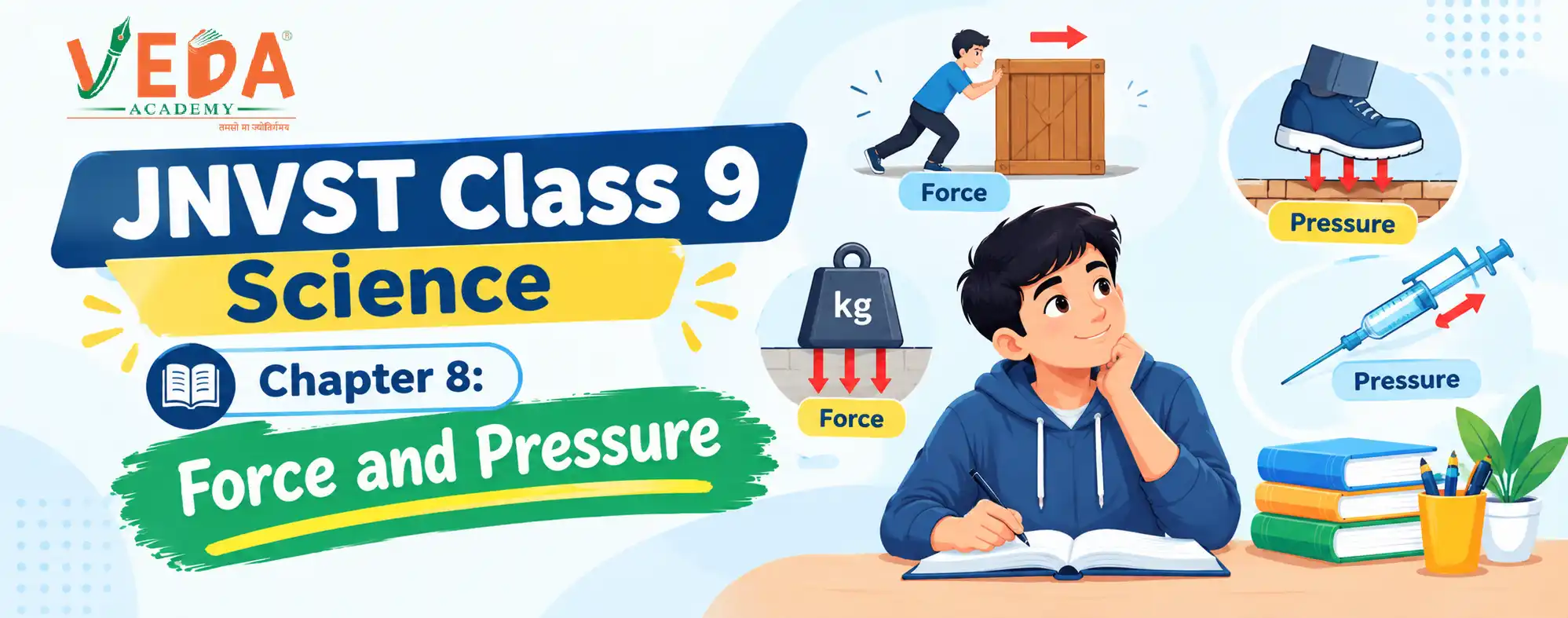
Chapter 8: JNVST Class 9 Science Force and Pressure
JNVST Class 9 Science Force and Pressure is an important topic for students preparing for the Navodaya Class 9 entrance exam. This chapter helps students understand how a force can move, stop, or change an object. It also explains pressure and how force acts on different surfaces.
Therefore, students should learn JNVST Class 9 Science Force and Pressure with simple examples. For example, when you push a door, you use force. Similarly, when you kick a football, the ball moves because of force. With easy notes, regular practice with JNV model papers, mock tests, important questions, PYQs, and JNVST Class 9 Science questions, students can understand this topic better. Moreover, good JNVST Class 9 Science study material can make learning faster and easier.
What Is Force?
Force is a push or a pull. We use force in many daily activities. For example, we push a chair to move it. We pull a drawer to open it. Thus, force can change the state of an object. It can make a still object move. It can also stop a moving object. In JNVST Class 9 Science Force and Pressure, students learn that force can:
Move a stationary object. Stop a moving object. Change the speed of an object. Change the direction of motion. Change the shape of an object. For instance, pressing a sponge changes its shape. Likewise, hitting a cricket ball changes its speed and direction.
Force and Pressure PDF
Do You Need Help With Your Homework
Types of Force
There are different types of forces. However, they can be understood through simple examples.
1. Muscular Force: Muscular force is the force produced by our muscles. For example, we use muscular force while lifting a bag, pushing a table, or riding a bicycle.
2. Frictional Force: Friction acts when two surfaces rub against each other. For example, friction between our shoes and the ground helps us walk safely.
3. Gravitational Force: The Earth pulls objects towards itself. This pull is called gravitational force. Therefore, when you drop a ball, it falls towards the ground.
4. Magnetic Force: A magnet can pull certain objects towards itself. This force is called magnetic force. For example, a magnet can attract an iron nail. These examples make JNVST Class 9 Science Force and Pressure easier to understand and remember. Also read: How to Choose the Best Coaching for Navodaya Vidyalaya Class 9 Admission Force can produce different effects. First, it can move an object. Second, it can stop an object. Third, it can change the direction of motion. Also, force can change the shape of an object. For example, when you squeeze a rubber ball, its shape changes. Similarly, when you stretch a rubber band, it becomes longer. Therefore, understanding these effects is important for JNVST Class 9 Science exam preparation. Pressure is defined as the amount of force applied to a specific area. To put it simply, pressure is force acting per unit area. A smaller area will create more pressure if the force acting upon it remains constant. For instance, it is easier for a sharp nail to pierce wood due to the smaller area at its tip. However, in the case of a wide surface area, the force will act over a larger area and thus create lesser pressure. We can see pressure in many places around us. For example, school bags have broad straps. The broad straps spread the weight over a larger area. As a result, they put less pressure on our shoulders. Similarly, sharp knives have thin edges. The small edge produces more pressure and helps us cut things easily. Also, tractors have wide tyres. These tyres spread the weight over a larger area. Therefore, they reduce pressure on the soil. Such daily-life examples make JNVST Class 9 Science Force and Pressure easier to learn. Liquids also exert pressure. Water pushes against the walls and bottom of a container. Moreover, liquid pressure increases with depth. For example, water pressure is greater at the bottom of a deep tank than near its top. Therefore, dams are made stronger at the bottom. This design helps them withstand greater water pressure. Students should understand these examples during JNVST Class 9 Science exam preparation because simple concept-based questions can be asked from this topic. Also Read: Navodaya Class 9 Admission Form 2027 Step-by-Step Process The air around Earth also exerts pressure. This pressure is called atmospheric pressure. Although we cannot see air, it is all around us. Therefore, air can exert pressure on objects. For example, when we use a straw to drink juice, atmospheric pressure helps move the liquid upward through the straw. Thus, JNVST Class 9 Science Force and Pressure connects science with many activities that we perform every day. JNVST Class 9 Science Force and Pressure helps students build a strong science base. The topic includes simple concepts, examples, and applications. However, students should not only read the chapter. They should also solve JNVST Class 9 Science questions regularly. Furthermore, students should revise definitions and examples. They should also practise questions based on force, pressure, friction, gravity, and atmospheric pressure. Good JNVST Class 9 Science study material can help students revise these concepts quickly. Preparation for JNVST Class 9 Science from Veda Academy enables students to understand science in an easy and systematic manner. The study material is prepared based on the JNV syllabus. The students can make use of notes for each chapter, practice questions, revision, and other helpful material. Furthermore, the lessons include conceptual clarity and consistent practice. JNV Online Classes by Veda Academy enable students to learn from their homes. The students can go through key topics, revise lessons, and solve questions through JNV online classes. Students who are seeking the best online classes for Navodaya Class 9 can make use of structured learning through Veda Academy. Likewise, students who are looking for Navodaya Class 9 online coaching can take advantage of its online resources. Consequently, students can make use of JNVST Class 9 Science study material, revision, and practice.Effects of Force
What Is Pressure?
Pressure in Daily Life
Pressure Exerted by Liquids
Atmospheric Pressure
Why Is Force and Pressure Important for JNVST Class 9?
Prepare with Veda Academy for the best coaching for Navodaya Vidyalaya Class 9 exam preparation