 Veda Store

- Navodaya Vidyalaya Notes
- JNVST Science Notes class 9
Crop Production and Management
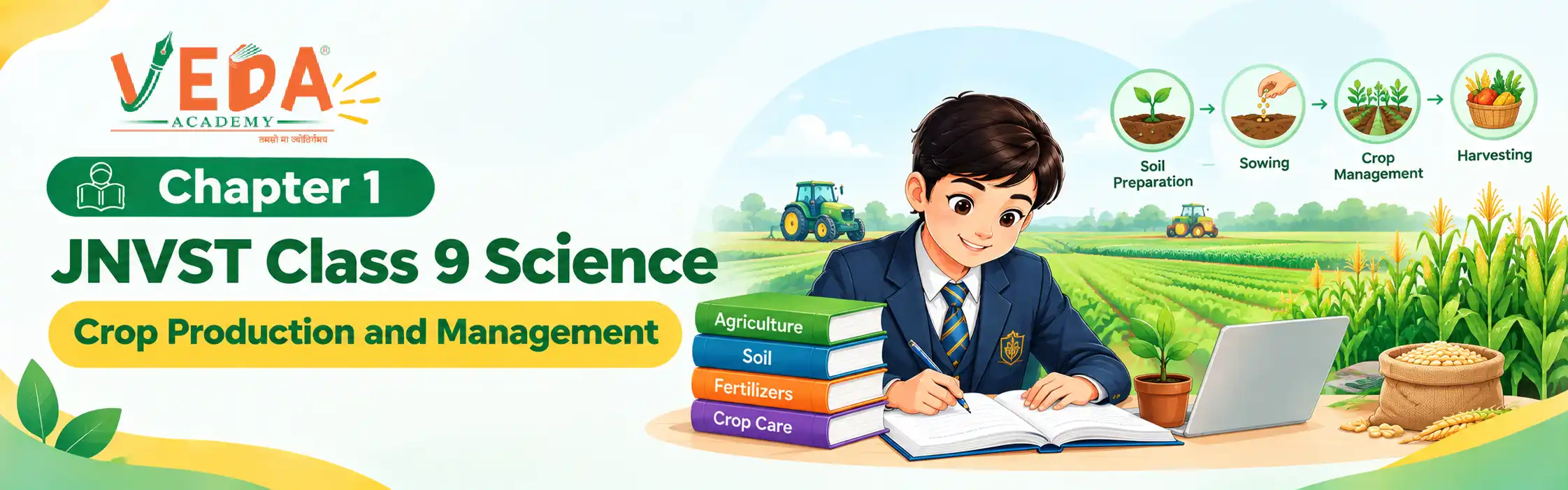
Chapter 1 JNVST Class 9 Science Crop Production and Management
JNVST Class 9 Science Crop Production and Management helps students learn how farmers grow crops. It explains the steps from preparing the soil to storing the final crop. Therefore, this chapter is useful for strong JNVST Class 9 Science exam preparation. Students also learn about different crops, farming tools, irrigation, manures, fertilizers, weeds, and crop protection. Moreover, simple examples make the topic easy to understand. With regular practice, students can solve JNVST Class 9 Science questions with better speed and confidence.
For this reason, students should study JNVST Class 9 Science Crop Production and Management carefully. Good notes and regular revision can make this topic much easier.
What Is Crop Production?
Crop production means growing plants for food and other useful products. Farmers grow crops such as wheat, rice, maize, pulses, vegetables, and fruits. However, crops need proper care to grow well. Farmers first prepare the soil. Next, they select good seeds. Then, they sow the seeds and provide water. After that, they add manure or fertilizers when needed. They also remove weeds and protect crops from pests.
Thus, JNVST Class 9 Science Crop Production and Management teaches the basic steps of farming in a simple way.
Also Check: JNV Class 9 Admission Form 2027 Out or Not Check Latest Update
Crop Production and Management PDF
Do You Need Help With Your Homework
Types of Crops
Crops are grown according to the seasons. There are two types of crops explained below:
Kharif Crops: Kharif crops are usually grown during the rainy season. For example, rice, maize, cotton, soybean, and groundnut are Kharif crops.
Rabi Crops: Rabi crops are usually grown during the winter season. Wheat, gram, peas, and mustard are common Rabi crops.
Therefore, students appearing for the JNVST entrance exam must know the difference between Rabi and Kharif crops as it is important.
Also Check: Navodaya Class 9 Syllabus 2027 Subject-Wise Complete Syllabus Farmers follow several steps to grow healthy crops. These steps are called agricultural practices. The main steps are: Preparation of soil Sowing Adding manure and fertilizers Irrigation Protection from weeds Harvesting Storage Each step has a special purpose. Therefore, students should understand the order of these steps while studying JNVST Class 9 Science Crop Production and Management. The first step is to prepare the soil. Farmers loosen and turn the soil with tools such as a plough. Loose soil allows roots to grow easily. It also helps air and water move through the soil. Moreover, turning the soil brings nutrients closer to plant roots. Thus, soil preparation creates a good base for crop growth. After preparing the soil, farmers sow seeds. They choose healthy and good-quality seeds because good seeds can produce healthy plants. Farmers may use traditional tools or seed drills for sowing. A seed drill places seeds at a proper depth and distance. Therefore, it can help farmers save time and reduce the wastage of seeds. Understanding sowing is another important part of JNVST Class 9 Science Crop Production and Management. Irrigation means supplying water to crops at regular times. Plants need water for growth and other life processes. Farmers use different irrigation methods. Traditional methods include wells and canals. Modern methods include sprinkler and drip irrigation. The sprinkler system spreads water like rain. The drip system supplies water close to plant roots. Therefore, modern methods can help save water. Unwanted plants that grow with crops are called weeds. They compete with crops for water, nutrients, sunlight, and space. Farmers remove weeds by hand or with tools. They may also use weedicides when suitable. Removing weeds at the right time helps crops grow better. Hence, weed control is an important part of JNVST Class 9 Science Crop Production and Management. When crops become fully grown, farmers harvest them. Harvesting means cutting and collecting mature crops. Farmers may harvest crops by hand or use machines such as combine harvesters. After harvesting, grains are separated from the chaff. This process is called threshing. As a result, harvesting prepares the crop for further use and storage. Proper storage protects grains from insects, moisture, rats, and other pests. Farmers dry grains before storing them. Large amounts of grain may be stored in silos or granaries. Small amounts can be stored in suitable containers at home. Therefore, storage is the final step in JNVST Class 9 Science Crop Production and Management. Also Check: Top Coaching for Navodaya Vidyalaya Class 9 Entrance Exam Preparation JNVST Class 9 Science requires students to understand basic science concepts. Crop production connects science with everyday life. Students can also find questions based on farming practices, crops, tools, and plant needs. For effective JNVST Class 9 Science exam preparation, students should first understand each concept. Next, they should revise important terms. Finally, they should practise JNVST Class 9 Science questions. Good JNVST Class 9 Science study material can make this process easier. It gives students important points in one place. Therefore, students can revise faster and remember key concepts. Veda Academy provides useful JNVST Class 9 Science study material for students preparing for the Navodaya entrance exam. The learning resources are prepared according to the JNV syllabus and focus on simple explanations. The study material can help students understand JNVST Class 9 Science Crop Production and Management step by step. It also supports regular revision and practice. Moreover, Veda Academy offers structured learning resources, such as notes, important questions, mock tests, and other learning support for their preparation.Agricultural Practices
Preparation of Soil
Sowing of Seeds
Irrigation
Protection from Weeds
Harvesting
Storage of Crops
Why Is JNVST Class 9 Science Crop Production and Management Chapter Important?
JNVST Class 9 Science Study Material by Veda Academy