 Veda Store

- Navodaya Vidyalaya Notes
- JNVST Science Notes class 9
Microorganisms and Food Preservation
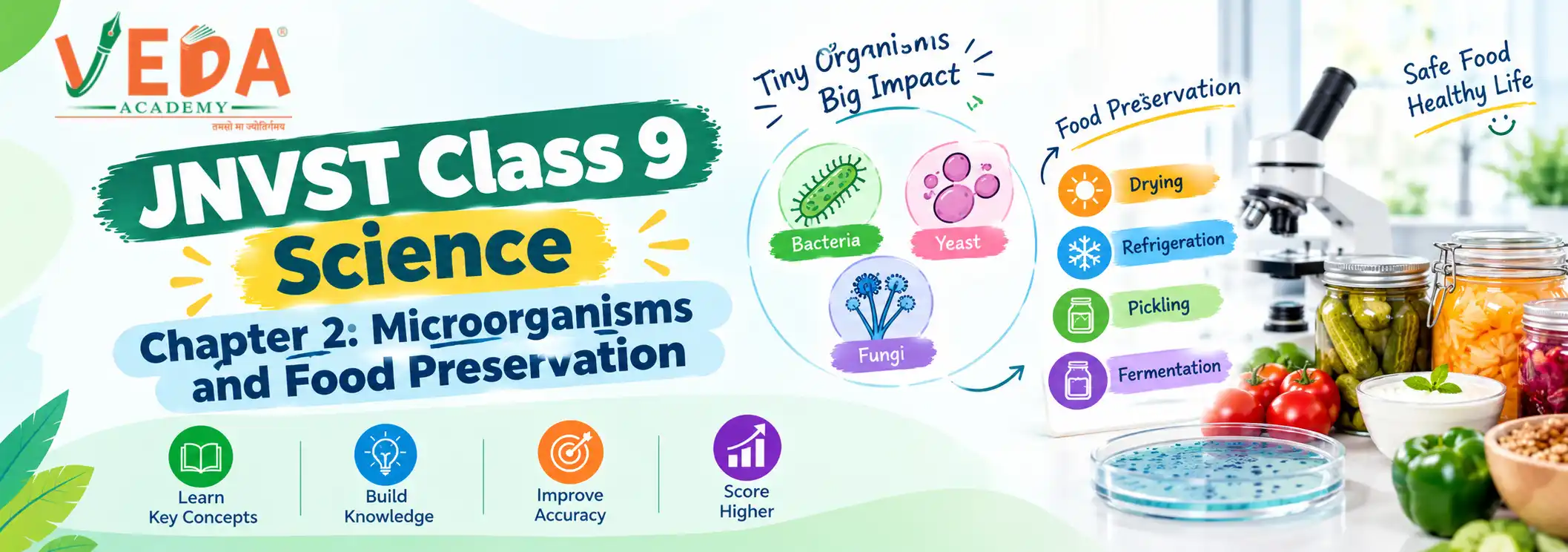
Chapter 2 JNVST Class 9 Science Microorganisms and Food Preservation
JNVST Class 9 Science Microorganisms and Food Preservation is an important topic for students preparing for the Navodaya Vidyalaya Class 9 entrance exam. This chapter helps students learn about tiny living things called microorganisms. Although we cannot see most microorganisms with our eyes, they are found almost everywhere.
For example, microorganisms can live in air, water, soil, food, and even inside living bodies. Some are useful, while others can cause diseases. Therefore, students need to understand their types, uses, harmful effects, and methods of food preservation.
With simple concepts and regular practice, JNVST Class 9 Science Microorganisms and Food Preservation becomes easier to understand. Moreover, this chapter can help students answer many JNVST Class 9 Science questions with confidence.
What Are Microorganisms?
Microorganisms are very small living organisms. They are so tiny that we usually need a microscope to see them. Therefore, they are also called microbes.
There are different types of microorganisms. These include:
Bacteria
Fungi
Protozoa
Algae
Viruses
However, viruses are different from other microorganisms because they can reproduce only inside living cells. Microorganisms are found in many places. For instance, they can be present in soil, water, air, plants, animals, and food. Some microorganisms are useful to us. On the other hand, some can cause diseases and spoil food.
That is why JNVST Class 9 Science Microorganisms and Food Preservation is an important chapter for students.
Also Check: Navodaya Class 9 Syllabus 2027 Subject-Wise Complete Syllabus
Useful Microorganisms
Bacteria help us make curd. For example, Lactobacillus changes milk into curd. Similarly, yeast helps us make bread during baking. It helps dough rise because it produces carbon dioxide during fermentation. As a result, bread becomes soft and fluffy. Microorganisms are also useful in making products such as:
Curd
Bread
Cheese
Pickles
Vinegar
Fermented foods
In addition, some microorganisms help farmers. Certain bacteria improve soil fertility by fixing nitrogen. Therefore, microorganisms also play an important role in agriculture. These points are useful for JNVST Class 9 Science exam preparation.
Microorganisms and Food Preservation PDF
Do You Need Help With Your Homework
Harmful Microorganisms
Not all microorganisms are useful. Some microorganisms can cause diseases in humans, animals, and plants. Such microorganisms are called pathogens. For example, some bacteria and viruses can cause diseases such as tuberculosis, cholera, typhoid, and common cold. Likewise, some microorganisms cause diseases in plants.
Microorganisms can also spoil food. Spoiled food may change its smell, colour, taste, or texture. Therefore, spoiled food can harm our health. As a result, food must be stored properly. This is where food preservation becomes important.
Also Check: How to Choose the Best Coaching for Navodaya Vidyalaya Class 9 Admission
What Is Food Preservation?
Food preservation means protecting food from spoilage. It helps keep food safe for a longer time. Microorganisms can grow quickly in suitable conditions. They need factors such as moisture, warmth, and nutrients. Therefore, reducing these conditions can slow down their growth. There are several methods of food preservation. These methods are simple and useful in daily life. Some common methods include:
Drying
Salting
Sugaring
Refrigeration
Heating
Pasteurisation
Using preservatives
Airtight storage
Understanding these methods is an important part of JNVST Class 9 Science Microorganisms and Food Preservation. Drying is one of the oldest methods of food preservation. In this method, water is removed from food. Microorganisms need moisture to grow. Therefore, when food becomes dry, microorganisms cannot grow easily. For example, grains, fruits, vegetables, and spices can be dried. Pickles may also be dried or prepared with salt and oil. Thus, drying helps increase the shelf life of food. Salt can also help preserve food. A high amount of salt reduces the water available for microorganisms. For example, fish, meat, pickles, and some vegetables can be preserved using salt. Therefore, salting is a simple method that has been used for many years. Students should remember this method for JNVST Class 9 Science questions. Sugar is another useful food preservative. A high amount of sugar reduces the available water in food. Therefore, microorganisms find it difficult to grow. Jam, jelly, and fruit preserves are common examples. However, food should be stored properly even after adding sugar. Clean containers and proper sealing are also important. Refrigeration is a common method used in homes. Low temperatures slow down the growth of many microorganisms. For example, milk, fruits, vegetables, cooked food, and other products can be kept in a refrigerator. However, refrigeration does not always kill microorganisms. Instead, it mainly slows their growth. Therefore, refrigerated food should still be used within a safe period. Pasteurisation is mainly used for milk. In this process, milk is heated to a suitable temperature for a short time. Then, it is cooled quickly. This process helps destroy many harmful microorganisms. Therefore, pasteurised milk is safer to consume when handled and stored properly. Pasteurisation is an important concept in JNVST Class 9 Science Microorganisms and Food Preservation. Some chemicals are also used to preserve food. They help prevent the growth of microorganisms. For example, sodium benzoate is commonly used in some food products. It may be added to items such as jams, juices, and squashes. However, food preservatives must be used in safe amounts. Therefore, students should understand their purpose instead of simply memorising their names. The topic JNVST Class 9 Science Microorganisms and Food Preservation covers basic science concepts that students should understand clearly. Questions may test definitions, examples, uses, harmful effects, or food preservation methods. For example, students may be asked: What are microorganisms? Name different types of microorganisms. How is curd prepared? What is pasteurisation? Why is salt used to preserve food? How does refrigeration help preserve food? Therefore, students should revise each concept and practise JNVST Class 9 Science questions regularly. Before the exam, students should revise the key points of JNVST Class 9 Science Microorganisms and Food Preservation.Remember these important facts: Microorganisms are very small living organisms. Bacteria, fungi, protozoa, and algae are microorganisms. Some microorganisms are useful. Some microorganisms cause diseases. Yeast is useful in baking. Lactobacillus helps make curd. Drying removes moisture from food. Salt helps prevent microbial growth. Sugar helps preserve jams and jellies. Refrigeration slows microorganism growth. Pasteurisation helps make milk safer. Proper food storage helps prevent spoilage. These points are useful for quick revision and JNVST Class 9 Science questions. First, read each topic carefully and understand the main ideas. Next, make short notes of important terms and examples. Then, solve practice questions after each chapter. Also, revise hard topics often. In addition, solve sample questions to check what you have learned. Students using JNVST Class 9 Science study material should give time to both learning and revision. Do not just memorise answers. Instead, try to understand each topic and learn why each process happens. Finally, use reliable Navodaya Class 9 online coaching to plan your studies. With regular study, revision, and practice, students can understand Science topics better and prepare with confidence. JNVST Class 9 Science Microorganisms and Food Preservation teaches students about microorganisms, their uses, harmful effects, and ways to preserve food. These ideas are useful for the exam and daily life. Therefore, students should study this chapter well and revise it often. Also, good study resources can make learning easier and more clear. Veda Academy offers JNVST Class 9 Science study material, online classes, practice questions, and syllabus-based learning support. For students looking for the Best online classes for Navodaya Class 9, Veda Academy provides simple and well-planned resources. Moreover, students can learn each topic, revise important points, and practise questions regularly with Veda Academy's JNV Online Classes.Food Preservation by Drying
Food Preservation by Salting
Food Preservation by Sugaring
Food Preservation by Refrigeration
Pasteurisation
Chemical Food Preservatives
Why Is JNVST Class 9 Science Microorganisms and Food Preservation Important?
Quick Revision of Microorganisms and Food Preservation
Tips for JNVST Class 9 Science Exam Preparation
Wrapping Up