 Veda Store

- Navodaya Vidyalaya Notes
- JNVST Science Notes class 9
Friction
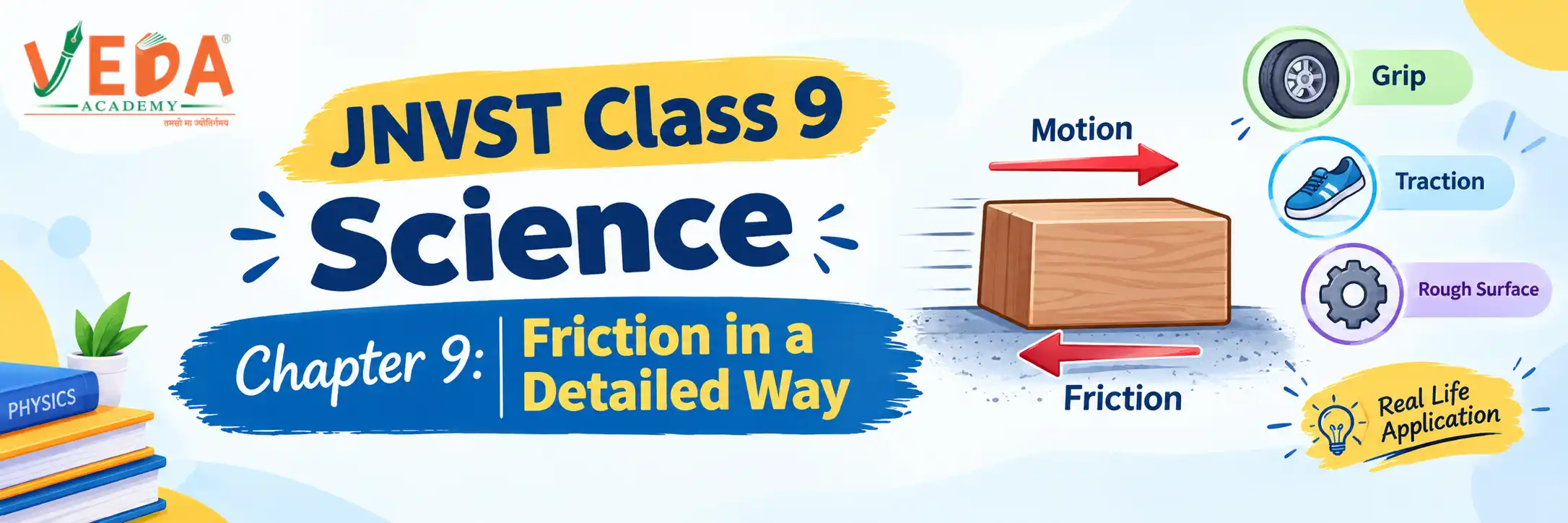
Chapter 9: JNVST Class 9 Science Friction in a Detailed Way
Imagine a world without friction; people will not be able to walk properly, hold a pencil, or stop a bicycle properly. Friction may seem like a small force, but it has a major role in everyday life. A reason it is considered an important chapter is that it is included in the JNVST Class 9 Science Friction for the Navodaya Class 9 Entrance Exam. It helps students understand the many common activities that happen around them, such as walking, writing, pulling brakes, and moving objects. Moreover, questions on friction can test your understanding of forces, motion, and everyday examples.
Therefore, learning this chapter with simple explanations, examples, and regular practice can make JNVST Class 9 Science exam preparation easier and more interesting. With the right JNVST Class 9 Science study material and guidance from Veda Academy JNV Online Classes, students can understand the topic clearly and prepare with greater confidence.
What is Friction?
Friction is the force that opposes movement between two objects. For example, when pushing a wooden box against the floor, the motion that happens between the wooden box and the floor is friction. However, friction is not harmful in most cases. Friction helps in walking without slipping and helps vehicles stop by using brakes. Thus, this chapter becomes important for JNVST Class 9 Science; the students learn how friction works and is useful in everyday life.
Friction PDF
Do You Need Help With Your Homework
Why Does Friction Occur?
No surface is basically considered smooth. Even a smooth surface has very tiny bumps and rough areas that cause friction. When an object hits the surface, these surface irregularities can cause friction. As a result, friction develops between the objects. Moreover, rough surfaces usually produce more friction than smooth surfaces.
However, for JNVST Class 9 Science exam preparation, students should remember this simple idea: A rough surface means more friction; on the other hand, a smooth surface means less friction.
Types of Friction in Science
There are basically 4 types of friction. Understanding each type of friction is important for students to answer the questions in the JNVST Class 9 Science Friction exam.
Static Friction: Static friction acts when the object remains still, and we try to move it. For example, a heavy wooden box remains still and may not move if pushed lightly. Static friction prevents the box from moving.
Sliding Friction: Sliding friction happens when two solid objects rub against each other. This force is slightly weaker in comparison to static friction. For example, rubbing hands against each other causes friction, or sliding down a stair railing is the best example of sliding friction.
Rolling Friction: This friction is much weaker than the other two, as it slows down when the object rolls over. For example, the ball rolls over the ground until it slows down and stops.
Fluid Friction: Here, the resistance force is faced by an object against any moving fluid or gas. The best example is swimming or skydiving. The object moves against the force.
Advantages & Disadvantages of Science Friction
The JNVST Class 9 Science Friction chapter has both advantages & disadvantages. So, students must prepare from JNVST Class 9 Science study material such as JNV Class 9 Mock Tests, Notes, and Important Questions. The JNVST Class 9 Science Friction chapter advantages & disadvantages are:
There are many ways of reducing friction between objects. Therefore, lubricants such as oil and grease can be used between moving machine parts. They create a thin layer between surfaces. Similarly, wheels and ball bearings can reduce friction. Moreover, smooth surfaces usually produce less friction. Moreover, smooth surfaces usually produce less friction. Therefore, these examples are useful for the JNVST Class 9 Science preparation because exam questions may ask students to identify ways to reduce friction. There are various scenarios where more friction is useful. For example, shoe soles have different patterns for better grip. Similarly, the tyres have grooves that help vehicles maintain contact with the roads. Furthermore, athletes often use special shoes to maintain better grip while running or playing sports. Therefore, friction is present in everyday life. We can see friction around us in everyday life. For example, while we walk, friction can be felt in our feet because friction acts between our feet and the ground. A pencil writes because friction acts between the pencil tip and paper. Likewise, brakes use friction to slow down vehicles. Therefore, JNVST Class 9 Science Friction is not only an exam topic. It is also connected to many activities in daily life. Questions regarding friction often come in the JNV exams, and for that, students should practise from the JNV Class 9 model papers and PYQs. Good JNVST Class 9 Science exam preparation needs clear concepts, regular revision, and practice. Veda Academy JNV Online Classes provide structured learning support for students preparing for the Navodaya Class 9 entrance exam. Veda Academy offers JNVST Class 9 Science study material prepared according to the JNV syllabus. Students can study concepts, revise important points, and practise exam-focused questions. The platform also supports students through online lessons and useful practice resources. As a result, learners can build confidence while preparing from home. For students searching for the best online classes for Navodaya Class 9, Veda Academy provides focused learning resources and Navodaya Class 9 online coaching designed around the needthe s of entrance-exam learners. How can we Reduce Friction?
How can we Increase Friction?
JNVST Class 9 Science Exam Preparation with Veda Academy, the Best Navodaya Class 9 Online Coaching